If you've ever stood in front of a machine that just failed, holding a voltage tester pen and a handheld thermal camera, you know the feeling. You have numbers. You have a thermal image. You still don't know what's wrong.
I've been reviewing test and inspection setups for about five years now—roughly 200+ devices a year, from handheld meters to full DAQ racks. One pattern keeps showing up: people buy tools as if they're collecting them, not building a measurement system.
The Single-Tool Illusion
Take the humble voltage tester pen. Fifteen bucks at any hardware store. Touch a wire, it lights up. Looks like a definitive answer.
Here's the thing: a tester pen can tell you a voltage is present. It can't tell you if that voltage is stable, if it's safe to work on, or if the signal is carrying the information you actually need. For a QC pass/fail, that might be enough. For production validation?
Probably. That's the problem.
Same with thermal imaging. People ask me, “What is a FLIR thermal camera? Should we get one for our maintenance team?” It's a great question. FLIR makes solid handheld thermal cameras—that's not the issue. The issue is what happens after you take the image. You save a JPEG. Someone maybe notes the location. Then next week, a different tech takes another image, and nobody can compare them meaningfully. Emissivity settings were different. Distance was different. The “hot spot” might be a reflection, not a fault.
It's tempting to think better hardware solves this. It doesn't.
The Problem Behind the Problem
What I see in audits, over and over: instruments are purchased in isolation, calibrated in isolation, and read in isolation. The result is a stack of numbers with no traceability.
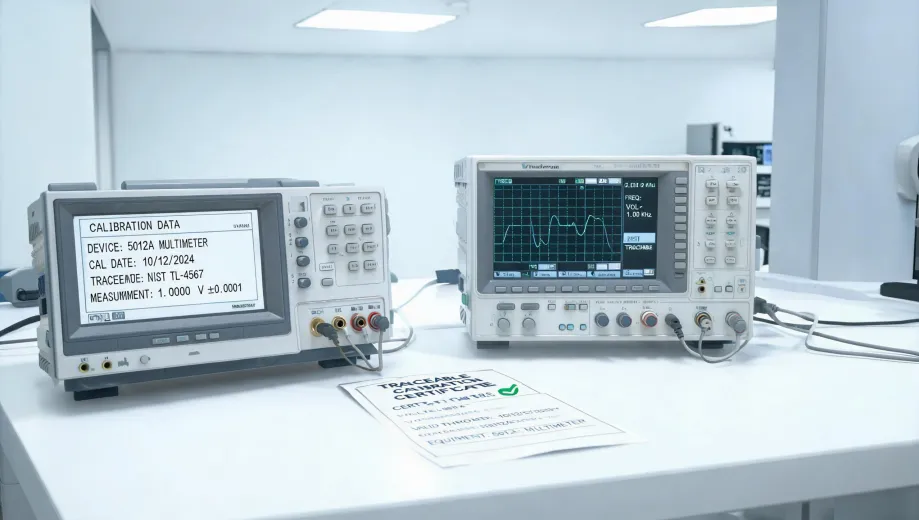
Per FTC advertising guidelines, claims have to be truthful and substantiated. For test equipment, your substantiation is calibration traceability. If a supplier hands you a test report from an uncalibrated meter, that report is essentially a rumor. Nice to hear. Not something you can base a 50,000-unit production decision on.
And yet that's exactly what happens when you rely on a single handheld tool. You get a number. You don't get a system that logs, trends, and verifies.
That's the part people miss about a National Instruments oscilloscope or a CompactDAQ system. The scope is good hardware on its own, sure. But the real value is that it connects to something: LabVIEW, a database, an automated test sequence, a calibration schedule. The measurement becomes part of a process, not an isolated event.
I still kick myself for a batch we approved back in Q1 2024. The vendor's test report looked clean—all readings within spec. We spot-checked one unit with a handheld thermal camera, saw nothing unusual, and signed off. Later, we found out their thermocouple was out of calibration. The boards ran hot in the field. $22,000 in rework and a missed launch date.
So glad we dodged a bullet on the next one. Before the next production run, we required calibration certificates with every test report and switched to a DAQ-based verification setup with National Instruments hardware and support. That decision probably saved the entire quarter.
“Probably” Is Not a Spec
Here's where I'll sound like a fanboy: I would rather pay for certainty than gamble with “probably.”
Cheaper test equipment has a hidden cost. It's not the price tag—it's the uncertainty. Where's the calibration document? Who do you call when the firmware acts up? Can you reproduce the measurement six months from now? With a random handheld device and a spreadsheet, the answer is usually “kind of, maybe, depends.”
National Instruments support is part of the product. I know that sounds like marketing, but when your line is down and the clock is running, a predictable support channel is worth more than the hardware itself. That's the time certainty premium. In March, we paid for a software support call that got us running in two hours. The alternative? Three days of a contractor poking at code and billing us anyway.
To be fair, not every situation needs a full NI system. If you just need to check whether a cable is live, buy the voltage tester pen. If you're doing a quick visual inspection on a motor bearing, a handheld thermal camera—even a FLIR—is a totally reasonable first pass.
Just don't build a quality decision on it.
What I'd Do Differently
If I could go back, I'd stop asking “what tool do I need?” and start asking “what system can I trust?”
Three things, in order:
- Define the decision you're making. Pass/fail? Trend analysis? Safety?
- Select a platform that can log, timestamp, and verify the measurement—like a National Instruments oscilloscope or DAQ module.
- Confirm there's a support path when it breaks, because it will eventually.
If you're specifying test gear for anything beyond a one-off check, the question isn't which spec sheet looks better. The question is: what happens when the answer isn't obvious? That's where platforms, calibration, and support earn their keep.
Bottom line: buy the cheap pen if you want a quick answer. But if you're responsible for a production decision, buy a system. The certainty is the spec that matters.