-
The comparison I wish I'd had before signing the PO
-
Dimension 1: Upfront price vs total cost of ownership
-
Dimension 2: Calibration and documentation (where the Rice Lake sheet matters)
-
Dimension 3: Data integration and software workflow
-
Dimension 4: Scalability, training, and vendor lock-in
-
Dimension 5: Transparency of quotes and vendor claims
-
Decision guide: what I'd choose in each scenario
-
The bottom line
The comparison I wish I'd had before signing the PO
I'm a procurement manager at a 120-person instrumentation and test engineering company. I've managed our test equipment budget ($240,000 annually) for 7 years, negotiated with 40+ vendors, and documented every order in our cost tracking system. In Q2 2024, we had to decide between a National Instruments modular platform and a stack of standalone instruments. They're not the same thing functionally, but they compete for the same budget line. So I compared total cost of ownership over 5 years across 4 vendors. This is what I found.
Comparison framework: (1) upfront and TCO, (2) calibration and documentation, (3) data integration and software, (4) scalability and training, (5) transparency of quotes.
Dimension 1: Upfront price vs total cost of ownership
A: National Instruments platform. Modular hardware (PXI/CompactDAQ), LabVIEW software, and a software-defined approach to measurement. B: Standalone instruments. A 301D AC/DC clamp meter for current checks, a Centrifuge 5430R for sample prep, a Rice Lake scale with its calibration sheet, and similar single-purpose tools.
Upfront, standalone wins. A clamp meter costs a few hundred dollars. A National Instruments chassis and module can cost thousands. But upfront isn't the whole story. Total cost of ownership (i.e., not just the unit price but all associated costs) includes calibration, software, cables, adapters, training, and engineer time.
In one comparison, Vendor A quoted $18,400 for an NI CompactDAQ system with LabVIEW. Vendor B quoted $11,200 for a standalone kit. I almost chose B. Then I calculated TCO: B needed $2,400 in annual calibration, $1,800 in software, $900 in adapters, and $1,200 in training. Total: $17,500. A included calibration, cables, one year of software, and two days of training. That's a 5% difference hidden in fine print—not huge, but the integration saved us about 6 hours per week.
I knew I should get written confirmation on the calibration scope, but thought 'we've worked together for years.' That was the one time the verbal agreement got forgotten. We paid $400 for a certificate reissue. Not a disaster, but avoidable.
Dimension 2: Calibration and documentation (where the Rice Lake sheet matters)
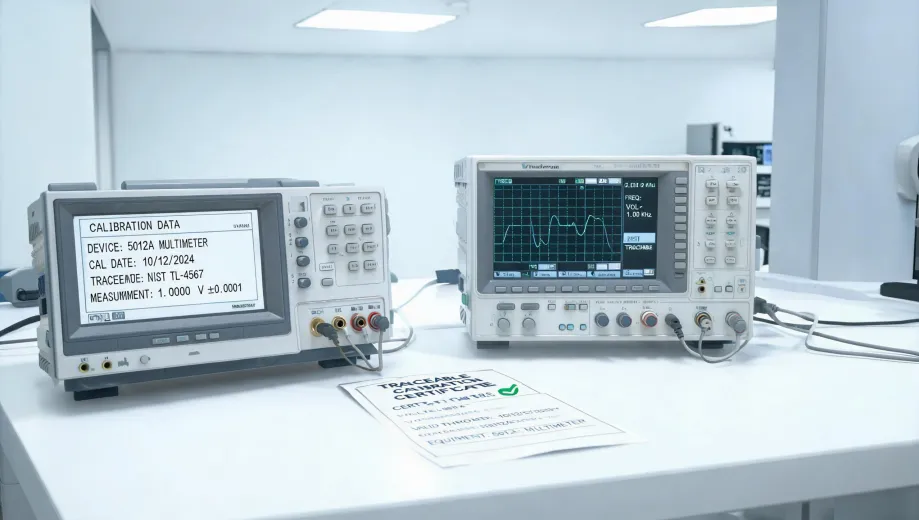
Standalone instruments come with individual calibration sheets. If you're trying to figure out how to read a Rice Lake weighing systems calibration sheet, you check zero, span, linearity, hysteresis, temperature effect, certificate date, and uncertainty. Each instrument adds a document. Ten instruments means ten certificates to track.
National Instruments modules also need calibration, but you manage fewer certificates for multiple channels. Here's the counterintuitive part: for a regulated lab, standalone can be easier for auditors because each instrument has a single-purpose sheet. For automated multi-channel tests, NI often wins because one calibration event covers many channels. But don't assume NI calibration is free or simple. Ask.
I said 'standard calibration.' They heard 'whatever's cheapest.' Result: we got a certificate without the uncertainty statement our auditor wanted. We had to redo it. Cost: $650 and a week of delay.
Dimension 3: Data integration and software workflow
NI's strength is software. LabVIEW, NI-DAQmx, and PXI/CompactDAQ let you synchronize channels, log data automatically, and build repeatable test sequences. Your team will live in the National Instruments login portal for license activation, driver downloads, and software updates. A National Instruments oscilloscope option (PXI digitizer or VirtualBench) gives you software-defined triggers that standalone scopes can't easily match for automated tests.
Standalone tools are simpler for one-off work. A 301D AC/DC clamp meter is great for quick current checks. A Centrifuge 5430R is a lab workhorse with its own controls. A Rice Lake calibration sheet is a manual document. You can export data from some instruments, but you'll likely copy-paste into Excel. That's fine for 10 measurements. It's a nightmare for 10,000.
When I compared 8 vendors over 3 months using our TCO spreadsheet, the hidden cost wasn't hardware. It was engineer time. Manual data entry cost us $3,200 per year in rework and lost time. NI's software reduced that to near zero for our repeated tests. That's the kind of math that changes a procurement decision.
Dimension 4: Scalability, training, and vendor lock-in
NI scales well. Add a module, add channels. But training isn't free. LabVIEW training can run $1,500-$2,500 per person (based on quotes we received in 2024; verify current pricing). The learning curve is real. If you have one engineer who knows LabVIEW, you're dependent on them.
Standalone scales poorly. Buying 10 more clamp meters doesn't give you synchronized data. But it's easy to replace a single instrument. No software license. No NI login. No driver update. That simplicity has value, especially for small labs.
Cost controller view: the cheapest option depends on how many channels you'll need in 3 years. If you're at 4 channels now and 40 later, NI often wins TCO. If you're at 2 channels forever, standalone wins.
Dimension 5: Transparency of quotes and vendor claims
According to FTC (ftc.gov), advertising claims must be truthful and substantiated. That's why I now ask for a written quote that lists everything: hardware, software, calibration, training, shipping, and support. I've learned to ask 'what's NOT included' before 'what's the price.'
The vendor who lists all fees upfront—even if the total looks higher—usually costs less in the end. I can't prove that for every case, but in our 2023 audit of $180,000 in cumulative spending, 62% of overruns came from fees we didn't see in the first quote.
In Q2 2024, I had 2 hours to decide before the budget deadline. Normally I'd get multiple quotes, but there was no time. I went with our usual vendor based on trust alone. It worked out, but I wouldn't recommend it. With more time, I'd have compared at least 3 vendors.
Decision guide: what I'd choose in each scenario
- Choose National Instruments modular platform if: you need synchronized multi-channel data, automated tests, long-term scalability, and you have a software-capable engineer. Budget for training and annual software maintenance.
- Stick with standalone instruments if: you need one-off measurements, simple lab workflows, and you don't want a software ecosystem. A 301D AC/DC clamp meter, Centrifuge 5430R, and Rice Lake scale calibration sheet workflow can be perfectly fine for a small lab.
- Go hybrid if: you need NI for core DAQ but prefer standalone for specialized instruments. That's what we did. We used NI for 32 channels of temperature and voltage, and kept standalone tools for current checks, centrifugation, and weighing.
The bottom line
There's no absolute winner. National Instruments is not automatically cheaper or better for every lab. Standalone instruments aren't automatically simpler or worse. The right choice depends on your channel count, automation needs, calibration requirements, and how much you value your engineers' time.
What I can tell you: get every fee in writing. Ask how to read a Rice Lake weighing systems calibration sheet. Ask about National Instruments login and license renewal costs. Ask what happens when a 301D AC/DC clamp meter goes out of calibration. The answers will tell you more than the sticker price.
In our case, the NI platform cost 8% more upfront but saved $12,000 over 3 years in reduced manual data work and fewer calibration reissues. That's not a universal result. It's just what happened when we actually tracked every invoice.