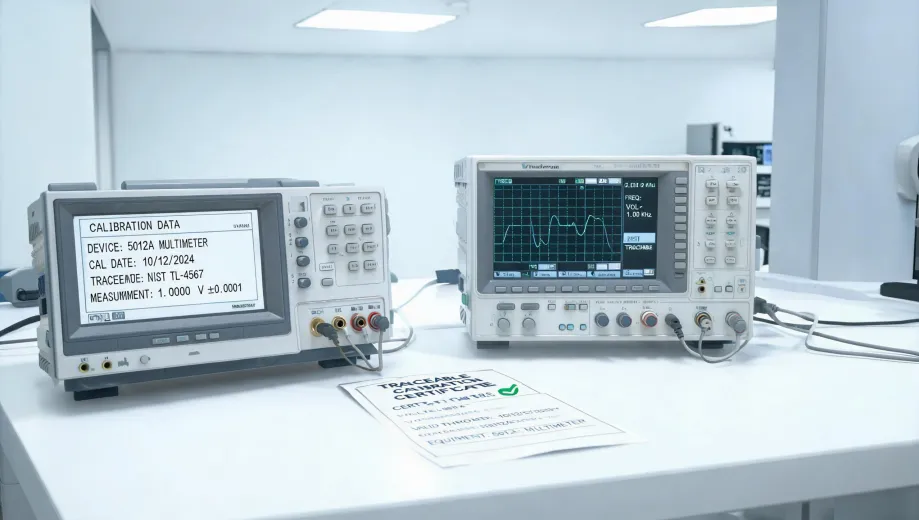
Every few months, someone in our engineering group forwards me a link with the subject line: “which Fluke multimeter should I buy?” I get it. The Fluke 179 true RMS digital multimeter is the default answer for a lot of labs. It's portable, trustworthy, and well documented. But after six years of managing test equipment procurement — and after one particular audit in 2024 — I think that starts the conversation in the wrong place.
If you've also been searching for National Instruments thermocouple modules, or you have an absolute digimatic caliper in your cart, you're not actually comparing like for like. You're comparing a tool, a component, and a system. The real question is what kind of measurement system you need, and what it will cost over three to five years.
I manage test equipment budgets for a mid-sized manufacturing company. We're not a research lab, and we don't have unlimited capital. That's exactly why total cost matters more to me than list price.
The Surface Problem: Everyone Starts With a Device
When engineers ask for budget approval, the conversation usually starts with a product. Someone wants a handheld multimeter. Someone watched a video about a National Instruments PXI or CompactDAQ system and likes the software. Another person wants the same caliper they used at their previous job.
That's natural. I have my own favorite pair of calipers. The problem is when we treat all of these as competing options at the same price point.
They're not competitors. They're different layers of measurement:
- A 179 true RMS digital multimeter is a portable, single-channel tool for spot checks.
- A National Instruments thermocouple module is one piece of a multi-channel data acquisition system.
- An absolute digimatic caliper measures dimensions, not electrical signals. Separate accuracy chain. Separate everything.
If you send a technician to read a 4-20 mA loop twice a month, the Fluke is probably the right call. But if you need eight thermocouple readings every five seconds for a 30-day process validation, a handheld meter is not just inconvenient. It's the wrong architecture. You'll be typing numbers into a spreadsheet and missing every transient between readings.
The Deeper Issue: You're Buying a System, Not a Tool
The real problem underlying “which Fluke multimeter should I buy” isn't brand loyalty or budget. It's that the meter is only one layer in a chain:
- Sensor contacts the process.
- Hardware measures the signal.
- Software samples, scales, corrects, and logs the data.
- A calibration record proves the chain is trustworthy.
- A report translates the data into a decision.
A handheld meter covers step 1 and part of step 2. Everything else is manual. And manual is expensive.
A National Instruments system, even a basic one, changes the shape of the problem. You're no longer comparing one device. You're choosing a platform for the whole chain: sensors, signal conditioning, software, and data management. According to NI's published specifications, each thermocouple module carries its own accuracy, cold-junction compensation, and offset characteristics — that's a level of detail a handheld meter simply doesn't show you.
Here's what took me years to understand: the value is in the system, not the hardware. A $500 meter that sits in a drawer is a bad purchase at any price. A $5,000 National Instruments thermocouple setup that automates a test you used to run manually every morning can pay for itself in about two years.
I have mixed feelings about that conclusion, because I'm naturally cheap. On one hand, I hate buying capability I don't need. On the other hand, I've watched us pay more in labor and rework than the “premium” hardware would have cost in the first place.
Here's a concrete example from my own spreadsheet: we run a weekly qualification test that takes one technician about 45 minutes to log manually. With loaded labor and error checking, that routine cost about $2,500 a year. The $5,000 National Instruments system didn't pay for itself overnight, but it did by the second year — and it gave us cleaner data.
The Cost of Getting This Wrong
In Q2 2024, I compared two quotes for a temperature and voltage logging setup. Vendor A bid $8,400 for a complete system: National Instruments cDAQ chassis, two thermocouple modules, a budget laptop, a basic LabVIEW license, and a day of training. Vendor B bid $4,800 for what looked like similar hardware.
I almost approved Vendor B. Then I asked what wasn't included.
LabVIEW license: $1,200. Third-party driver package: $450. Shipping and handling: $350. Total: $6,800 before any of our engineering time. Still lower than Vendor A, right? But Vendor A also included a calibration certificate and a day of training. Vendor B didn't. Our engineer spent a week getting the system to work. At a fully loaded cost of $2,000 a week, Vendor B came to $8,800 before revalidation risk. Vendor A was the cheaper option.
The surprise wasn't the price gap. It was how many costs were hiding behind the word “hardware.”
I've now built a simple rule into our procurement policy: any quote below $5,000 has to include a statement of what's not covered. Shipping. Software. Calibration. Training. Support. If the vendor won't list those, we keep shopping.
The other side of the mistake is just as expensive. I remember a validation that had to be redone because a thermocouple channel drifted 1.5°C between calibration cycles. The redo cost us $1,200 in materials and three weeks of schedule — more than the $900 upgrade we had turned down six months earlier.
So the real cost isn't the chosen tool. The real cost is:
- Buying a second device because the first didn't export data the way you needed.
- Rebuilding reports by hand because there was no software integration.
- Discovering a calibration gap during a customer audit.
- Losing a test because nobody could prove which sensor was on which channel three weeks later.
A Better Way: Start With the Workflow, Then Buy the Hardware
I'm not going to end with a list of recommended products. The process matters more than the model.
- Write down what success looks like. What report do you need at the end? What decision will someone make from this data?
- Count the channels and the data rate. One channel, occasional spot checks? Buy a handheld meter. Eight channels, continuous logging for a month? Buy a data acquisition system.
- Add software and training to the budget from day one. National Instruments systems are harder to justify for a one-off test, easier to justify if you'll build more than one automated measurement.
- Ask every vendor for a fully itemized quote: sensors, signal conditioning, software, cabling, calibration, training, and support.
- Buy a little more capacity than you need today. But don't buy a 48-channel system for a single sensor. That's museum-grade overkill.
Maybe you still decide that a Fluke 179 true RMS digital multimeter is the right purchase. Great. I wouldn't argue against it. If you're a solo technician doing same-day turnarounds, a high-end DAQ might be overkill. The point isn't to push you toward National Instruments or any other vendor. The point is to base the decision on the measurement system you're actually building, not on the search query you happened to type.
And if you're looking at an absolute digimatic caliper and a National Instruments thermocouple system in the same budget cycle, stop for a second. Those are different metrology domains. One doesn't replace the other. Neither one replaces a data acquisition system.
List the full measurement procedure first. Then choose the tools. Then ask what's not included. Every single time.