I'm not an engineer. I'm the person who signs the purchase orders and then has to explain to an engineering manager why their National Instruments module is on backorder. That gives me a weirdly useful perspective on test equipment buying—because I've seen the same request arrive a dozen different ways, and the right answer changes with the situation.
If you've landed on this page, you're probably trying to make sense of a few overlapping product categories: National Instruments oscilloscopes, component sensors like ultrasonic flow sensors, and the endless "which sensor brand should we use" debate (IFM vs. Omron vs. Keyence). Here's what I've learned after processing roughly 80 equipment orders a year since 2020: there is no universal best. There's only the best fit for your specific setup.
Start Here: The Three Buying Situations
Every request I've handled tends to fall into one of three scenarios. Your answer depends on which one you're in.
- Scenario A – You need a standalone instrument for a known task. Example: a technician wants a bench oscilloscope, or you got a quote for 10 multimeters and need to sanity-check the price.
- Scenario B – You need a flexible test system that will change over time. This is where National Instruments modular gear earns its keep.
- Scenario C – You're replacing or comparing individual sensors. Ultrasonic flow sensors, photoelectric sensors, proximity sensors—and the IFM/Omron/Keyence question.
Scenario A: Single Instruments and the "10 Multimeter Price" Question
When an engineer asks for "just an oscilloscope," I used to default to whatever brand was already in the building. That worked—until it didn't. In 2022, we bought a standalone benchtop scope for a quick project, and then the project expanded. The scope's data couldn't be integrated with our existing LabVIEW setup without a separate import process. It wasn't a bad scope, but it locked us into a workflow that didn't scale.
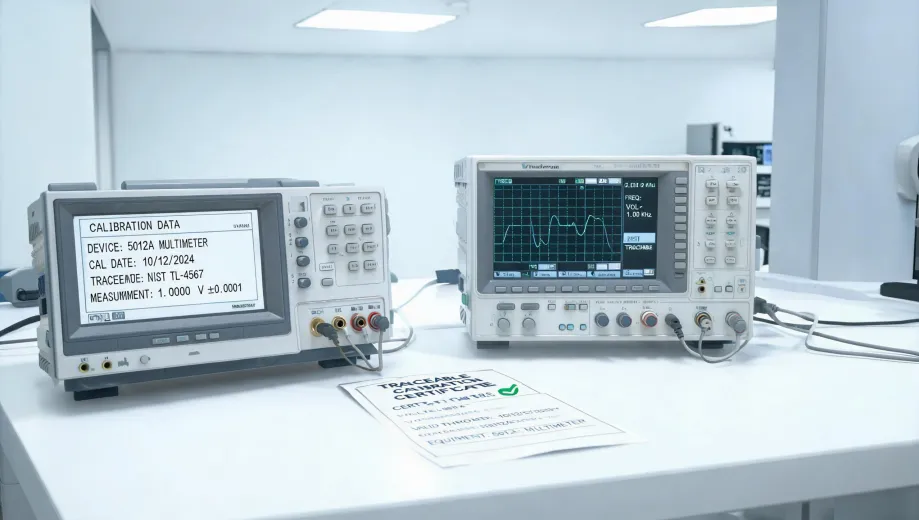
Here's the thing: National Instruments oscilloscopes aren't like bench scopes from other manufacturers. NI sells oscilloscope digitizers that live inside a PXI chassis or a CompactDAQ system. They give you the same waveform measurement, but the data goes straight into software. If you only need eyeball verification, a standalone scope is cheaper and simpler. If you think you'll need automated measurement later, the modular route saves you from buying twice.
To give you a rough sense of price: a standalone 100–200 MHz bench scope might cost $500–$1,500. A comparable NI oscilloscope digitizer module, according to NI's product pages and rep quotes I got in early 2025, starts around $2,000–$4,000—and that doesn't include the chassis or controller. The sticker shock is real. But the NI module includes software, synchronization, and integration that a bench scope can't match.
What about the "10 multimeter price" search? I get that one a lot. For a batch order of 10 basic digital multimeters, you're probably looking at $150–$500 total for decent mid-range units, depending on specs and calibration certificates. That's not a National Instruments conversation—that's just buying a tool. Here's a procurement trap I've hit: the cheapest quote often excludes calibration. If your company needs ISO-certified lab equipment, add $15–$40 per meter to get calibration paperwork. The no-cert price will make you look good until an auditor asks for the docs.
Scenario B: When NI Component Sensors and Modular Systems Make Sense
If you're building a test rig that will grow with your product line, National Instruments is usually the right conversation. I say "usually" because their systems are an investment, both in dollars and in learning curve. But the total cost of ownership can be lower than a Frankenstein setup of separate instruments.
This is also where "national instruments component sensors" comes in. When people search that phrase, I think they're really asking about NI's measurement components—like thermocouple input modules, current/voltage conditioners, or bridge completion modules—rather than the actual transducers. NI doesn't make every sensor, but they do make signal-conditioning components that work with third-party sensors. For example, we needed an ultrasonic flow sensor on a test loop last year. The sensor itself was from a specialized manufacturer, but we fed it into an NI CompactDAQ module. That combination gave us something a standalone flow meter couldn't: time-synchronized data alongside pressure, temperature, and vibration values in the same software.
What was best practice in 2020 may not apply in 2025. Five years ago, I would have told you to build a system around whatever DAQ platform your senior engineer already knows. Today, the integration with cloud data and the ability to reconfigure modules in software has shifted that advice. But the fundamentals haven't changed: know your channel count, sample rate, and sensor types before you call an NI distributor. Don't let a vendor design your system around modules you'll never use.
One more budget note: LabVIEW is now mostly subscription-based, so plan for that as a recurring operational expense. A lot of first-time buyers forget to include software when comparing NI against a standalone instrument.
Scenario C: IFM Sensors vs. Omron vs. Keyence—A Buyer's View
Of all the searches that land on this topic, "how ifm sensors compare with omron and keyence" is the one I can speak to most directly. I've bought all three. Here's the honest comparison from an admin buyer's perspective, not an engineer's.
IFM
IFM pricing is rarely the cheapest, but their documentation is consistently solid. Their datasheets include wiring diagrams that actually match our machines, which reduces support calls. For an ultrasonic flow sensor or a level sensor that needs to be reliable with no fuss, IFM is my default when downtime costs more than the part.
Omron
Omron tends to win when you have an existing control system, because their sensors integrate cleanly with Omron PLCs. We've also found them easier to source through regional distributors with shorter lead times. Price is competitive, especially on volume.
Keyence
Keyence has the most impressive sales support—they'll bring demo units and help with selection. Their sensors are good, but you're paying for that service. For our use, Keyence's edge cases, like tiny object detection, are worth the premium. For basic presence sensing, it's hard to justify the price gap.
Here's a real quote comparison from one of our projects: we needed an ultrasonic flow sensor with a 4–20 mA output. In late 2024, our vendor quoted $650 for IFM, $540 for a comparable Omron, and $780 for Keyence. We went with IFM because of lead time, not price. Your situation may be different.
One caveat: my experience is based on mid-sized B2B manufacturing and test setups, not high-volume OEM production. If you're embedding thousands of sensors into a product, your cost-per-unit math will look completely different. I can't speak to that.
How to Tell Which Scenario You're In
Not sure which of the above matches you? Ask yourself three questions:
- Is your requirement fixed next year? If yes, buy a standalone instrument or sensor and keep it simple. If no, lean modular—NI PXI or CompactDAQ.
- Does the measurement need to live in software with other data? If yes, National Instruments makes more sense. If it's a visual pass/fail check, save the budget.
- Are you making a long-term sensor platform choice? Then the IFM/Omron/Keyence comparison matters. If it's a one-off replacement, buy whatever is in stock locally.
Hit "confirm" on that purchase order and then immediately second-guess it? You're not alone. I've done it more times than I can count. The trick is to define your scenario first, then the brand and model decisions get easier.
Prices I've mentioned are from vendor quotes I received in late 2024 and early 2025—verify current rates because this market moves quickly. And if you want to talk through a specific order, find a systems integrator who understands your application, not just the catalog page.