-
Step 1: Write down the exact measurements you'll take
-
Step 2: Match the CAT rating to where you'll use it
-
Step 3: Decide: snapshot or data logger?
-
Step 4: Check the accuracy spec before you fall in love with a model
-
Step 5: Add probes, leads, and calibration to your order—not as a surprise
-
Common Mistakes to Avoid
-
The Bottom Line
If you're here from the phrase which Fluke multimeter do I need—and you're on a deadline—this is the checklist I use when clients ask me to rush-order test equipment. It's five steps. Do them in order. Don't skip step 4.
In my role coordinating instrument orders for manufacturers and test labs, I've handled 200+ rush orders in the last two years. Most of them weren't for exotic gear. They were for a basic multimeter, a calibration check, or a data logger that should have been ordered earlier. Time, feasibility, risk: that's what I think about every time a rush request lands.
Here's the thing: the best answer to "which Fluke do I need" isn't a model number. It's a list of requirements. Once you have the list, the model picks itself.
Step 1: Write down the exact measurements you'll take
Don't just say "electronics." Be specific.
- AC or DC voltage? Up to what voltage?
- Current? If so, do you need to break the circuit, or can you clamp around the wire?
- Resistance, capacitance, frequency, temperature?
- Process signals, like a 4-20 mA loop from a flow meter Promag 10? If yes, you need a meter that measures mA.
Why does this matter? Because a Fluke 117 works great for building controls, but it won't measure current without breaking the wire. A Fluke 87V goes up to 10 A. A clamp meter like the Fluke 325 measures current around a wire. The right choice follows from the workload, not the brand.
If you're not measuring anything yet, stop. Borrow a meter first. Don't buy a $400 instrument for a job that needs a $35 one, and don't buy a $35 meter for a $400 job. The list is what determines which side you're on.
Step 2: Match the CAT rating to where you'll use it
Most people skip this. Don't.
CAT ratings tell you how much transient energy the meter can survive. Per IEC 61010-1, a meter rated CAT III 600V is intended for distribution panels; CAT II is for outlets and powered equipment. If you work at the utility service entrance, you want CAT IV.
In my first year, I made the classic rookie mistake: I ordered CAT II meters for a technician who was going to work in a panel. The meter was fine on the bench, but it failed the site safety review. Cost us a reorder and $85 in expedited shipping. Not my favorite memory.
If you're not sure, choose the higher rating. The price difference between CAT II and CAT III on a handheld is usually small—smaller than the cost of one more rush shipment.
Step 3: Decide: snapshot or data logger?
This is where the "multimeter" search breaks down.
A multimeter gives you a reading at the moment your hand holds the probe. If you need to leave a measurement running overnight, or capture a temperature curve over eight hours, you need a data logger, not a statement of "this reads 24.3 V right now."
Some Flukes, like the 289, log internally. That can be the right answer. But if you need multiple channels, or you want to synchronize voltage and thermocouple readings, a National Instruments data logger makes more sense. Search for data logger national instruments on ni.com and you'll find the CompactDAQ platform: a small chassis that accepts different modules for voltage, current, thermocouples, and more. If you're already automating tests with LabVIEW, that same CompactDAQ system feeds directly into your existing software.
What was best practice in 2020 may not apply in 2025. The fundamentals of electrical measurement haven't changed, but the execution has transformed. A logging multimeter is a good tool. It's just not a modular data acquisition system.
Step 4: Check the accuracy spec before you fall in love with a model
Fluke publishes accuracy specs in every manual. The number to look for is DC voltage accuracy and the calibration interval—usually one year.
If your test procedure requires 0.01% DCV accuracy, a handheld multimeter might not pass metrology review. A 6½-digit bench DMM or a National Instruments PXI DMM will get you microvolt-level resolution and accuracy in the parts-per-million range. Different tools for different tolerances.
What most people don't realize is that "standard accuracy" only applies if the instrument is in calibration. If the calibration certificate is expired, the published spec doesn't hold. That plain fact has caused more than one failed audit.
Step 5: Add probes, leads, and calibration to your order—not as a surprise
In my experience, the meter itself is rarely the emergency. The missing accessory is.
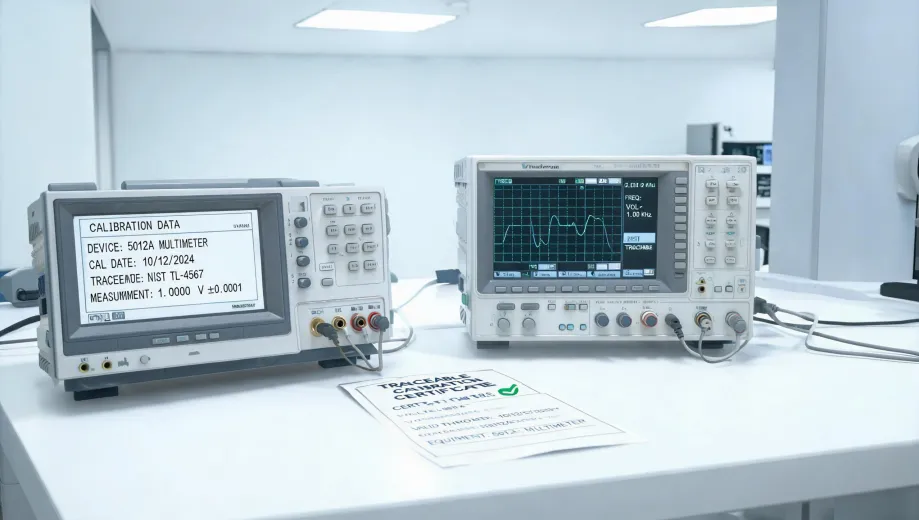
Here's something vendors won't tell you: the first quote often leaves out test leads, alligator clips, thermocouple adapters, and the calibration certificate. A meter without leads is useless. A meter without a traceable calibration cert can be worse than useless in an ISO audit.
When I'm triaging a rush order, I ask two questions before quoting:
1. Does this need a NIST traceable calibration certificate?
2. Do the probes in stock physically fit the meter's jacks?
Yes, question 2 sounds dumb. I've shipped a "complete" meter kit with the wrong probe connectors. That's why this checklist exists.
Common Mistakes to Avoid
- Buying current capability you don't need, or skipping it when you do. If you work on 4-20 mA loops—say, a flow meter Promag 10 signal—make sure the meter measures mA. Not all handhelds do.
- Ignoring the frequency bandwidth. If you're troubleshooting VFDs or other non-sinewave sources, you need true RMS and enough bandwidth to capture the harmonics.
- Using a multimeter when you need an oscilloscope. If you're verifying a 2465 oscilloscope's output, a multimeter can check supply rails, but it can't show you timing or waveform shape. Use the scope's self-calibration and a known reference signal.
- Waiting until 4:50 PM on Friday. If there's any chance you'll need a NIST cert or a custom probe set, order before the weekend. "Estimated delivery" and "guaranteed delivery" are not the same thing.
The Bottom Line
There's something satisfying about a well-specified instrument. After the research and the paperwork, seeing a technician open a box with exactly the right meter, probes, and calibration cert—that's the payoff. Much better than a rush charge and a panic.
Which Fluke multimeter do you need? Go through the list: measurements, CAT rating, logging, accuracy, accessories. If you're mainly measuring voltage and resistance on a bench, a Fluke 117 or 115 is enough. If you're working in panels, step up to CAT III and current capability—something like the 87V. And if you're logging data over time, don't try to force it through a handheld. A National Instruments data logger is the right tool for that job.
Start the checklist. It takes 15 minutes, and it'll save you the expedited shipping.