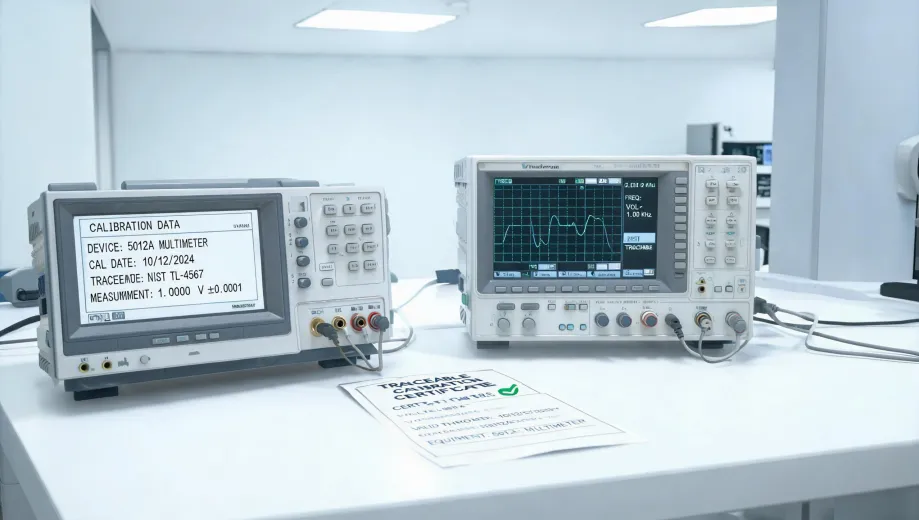
The deadline was Friday at 4:00 PM. It was Tuesday, 2:47 PM, and the lab was quiet. Too quiet.
I was staring at the export screen of our old 8-channel data logger. Instead of temperature readings, the file contained a string of ASCII gibberish. Not numbers. Garbage. The LEDs cycled like nothing was wrong, but the data was just... gone.
The repair shop actually laughed when I called. “That model? We stopped stocking parts three years ago.”
Here's the thing: we had eleven thermocouples already wired to a test rig, logging thermal profiles for a polymer stability study. And the client needed that data by Friday afternoon. Missing the deadline triggered a penalty clause in the contract: $15,000, plus the delightful task of explaining to our biggest customer why their product launch was now delayed.
Our lab is solid, but we're not a showcase for fancy equipment. We have a calibrated spectrophotometer that we're genuinely proud of. There's an Eppendorf centrifuge 5804 in the corner that's older than the new intern—but honestly, it still runs like a champ. And we have a Mettler Toledo pH meter that everyone treats like a museum piece. That same morning, I was showing the new intern how to use Mettler Toledo pH meter. Temperature logging? We'd always gotten by with that old workhorse.
Until we didn't.
The Cheaper “Compatible” Option
Panic sets in fast when a $15,000 deadline is on the line. I called every lab supplier I knew. One vendor had a “compatible” thermocouple module in stock. Third-party, they said, but it works with NI DAQ systems. And the price? $300 less than National Instruments' own NI-9214 module.
Did I suspect “compatible” meant something different than “certified”? Sure. Did I order it anyway? Yes. Because it was $300 cheaper, and in stock, and the deadline was 72 hours away. Budget pressure is real, and I convinced myself this was a smart call.
It wasn't.
The module arrived Wednesday morning. The install went from “fine” to “oh no” to “what have I done” in about four hours. The vendor's software claimed to support LabVIEW, but my freshly-installed LabVIEW 2024 refused to recognize the module. I spent nine hours digging through National Instruments downloads, NI community forums, and every troubleshooting guide I could find. The forums weren't charitable. “Third-party modules aren't guaranteed to work with NI-DAQmx,” one thread said. “You should check the compatibility list first.”
Thanks. Now I know.
The $400 Rush Fee
Thursday, 9:00 AM. I called our National Instruments account rep, fully expecting a two-week lead time and a “you should've ordered sooner” speech. Instead, she told me the NI-9214 was in stock in the U.S. She also sent the spec sheet: 16 inputs, 24-bit resolution, and an official compatibility list that included LabVIEW 2024. No guesswork. No “maybe.” The catch? A $400 overnight shipping fee for next-day delivery.
Now here's where I almost made the same mistake twice. I hesitated. $400, on top of the $2,100 module price, for shipping? That feels absurd, right?
Maybe. But then I ran the actual numbers.
The “cheap” module had already burned $300. The rush fee was $400. The penalty for missing the deadline was $15,000, plus the goodwill of a client who probably wouldn't forgive “our logger died and we tried to save money.” The math wasn't even close.
“Do it,” I said.
FedEx arrived Friday at 8:15 AM. Unboxing the NI-9214, installing it in the chassis, and loading the official NI-DAQmx driver from National Instruments downloads took me about an hour. By 10:30, all eleven thermocouple channels were streaming clean data.
We sent the final report at 3:50 PM Friday. The client's reply? “Perfect. Thanks.”
What I Learned (The Hard Way)
Here's what I should have understood from the beginning:
The rush fee wasn't for speed. It was for certainty. Overnight shipping is just a side effect. What NI sold me was the guarantee that a specific product, with specific drivers, would work. No “maybe,” no “if you tweak this config file,” no “have you tried reinstalling Windows?”
Is the $300 savings worth the risk? The answer depends on what you're risking. In my case, the uncertain cheap option ended up costing more than the certain expensive one: $300 wasted, 20+ hours lost, and the very real possibility of a $15,000 penalty. “Probably works” is the most dangerous phrase in a lab.
I didn't fully understand the value of delivery certainty until I was staring at that penalty clause. The vendor failure in February 2024 changed how I think about backup planning. One missed deadline makes redundancy feel like cheap insurance.
From the outside, a $300 saving looks smart. The reality? A $300 loss, a ton of troubleshooting time, and a near-miss with a client contract. What you don't see in the price comparison is the cost of guessing.
To be fair, National Instruments isn't the right choice for every lab. If you're doing routine testing with mature systems and flexible timelines, generic gear can get the job done. I'm not saying every purchase should be the premium brand. But when a deadline is real and non-negotiable, the calculation shifts. The cheapest quote isn't the cheapest if it can't deliver when it matters.
Looking back, my biggest mistake wasn't choosing the third-party module. It was assuming “compatible” meant “guaranteed.” Assumptions are expensive. In the lab, they're the most expensive thing you can buy.
Now, our team has a checklist. First, verify compatibility lists before buying anything—NI publishes them, use them. Second, check the National Instruments downloads page for certified drivers before you commit to a purchase. And third, keep a contingency plan for critical deadline work. We also have a standing agreement: when a deadline is on the line, we order from National Instruments with rush shipping if needed. The premium is just the cost of sleeping at night.
Why does this matter? Because in the middle of an emergency, you don't have time to verify twenty forum threads. You need one official source that says “use this driver, follow this wiring, and it will work.” That's what NI delivered. And that's exactly what a National Instruments thermocouple module is worth to us: $400, a saved deadline, and a client who still trusts our lab.
If you've ever been stuck with a dead logger and a ticking clock, you know the feeling. It's not just about money—it's about credibility. And once you lose credibility, you don't get it back with a discount coupon.
So, the $400 rush fee? Best $400 our lab has ever spent. It bought certainty when certainty was the only thing that mattered.
Don't wait until your own deadline is 72 hours away to learn this one. Trust me on this.