- Step 1: Map Your Measurement Needs to Module Capabilities
-
Step 2: Consider the Software Ecosystem Cost (It's Often the Real TCO Driver)
-
Step 3: Compare Per-Channel Cost (Not Just Module Price)
-
Step 4: Check the Hidden Costs of Calibration and Certification
-
Step 5: Future-Proof for Mixed-Signal Systems
-
Common Mistakes to Avoid
If you're upgrading a production test line, building a new R&D rig, or just tired of swapping handheld meters for every measurement type, this checklist is for you. It's designed for engineers and buyers who need a bench- or system-grade DMM that fits into a larger automated setup—not just a pocket meter for quick checks.
I've managed procurement for a mid-sized test equipment company for about 6 years, and I've documented over $450k in measurement hardware orders. My experience is mostly with modular systems based on PXI and CompactDAQ platforms. If you're buying purely standalone handheld DMMs for field work, your cost structure will differ—but the principles here still apply.
Here's a 5-step checklist to help you avoid the common pitfalls (and hidden costs) in digital multimeter selection.
Step 1: Map Your Measurement Needs to Module Capabilities
Don't start with a budget line item. Start with a signal inventory.
List out the specific measurements you'll be making over the next 12-24 months: voltage ranges, current types, thermocouple channels, resistance ranges, and any specialty measurements like capacitance or frequency. Digital multimeter modules—especially those from platforms like NI—are not one-size-fits-all.
Checkpoint: Write down 3 signals you're confident about, and 1 you're uncertain about. Use that unknown to define your flexibility requirement.
Checklist item: Confirm the module's resolution (digits) matches your highest accuracy need.
A 6.5-digit module like the NI PXIe-4065 costs less than a 7.5-digit model, but if you're measuring sub-millivolt signals, the lower resolution will cost you in noise filtering. I've seen teams buy a 6.5-digit for $1,800, then spend $600 on external preamps because they didn't check this step. That's a 33% hidden cost.
Step 2: Consider the Software Ecosystem Cost (It's Often the Real TCO Driver)
This is the step most checklists miss. The hardware price is visible; the software integration cost is hidden.
From the outside, it looks like all digital multimeters are interchangeable. The reality is that integrating a standalone meter into LabVIEW or your existing test automation software can require drivers, development time, and debugging—especially if you pick a vendor with limited API support or proprietary protocols.
Checkpoint: Verify that the DMM has published, tested drivers for your software environment (e.g., LabVIEW, .NET, Python). NI's own modules (like the DMM in their PXI-4070 series) come with NI-DMM driver, which integrates directly with LabVIEW. Third-party meters may need extra VISA or serial programming.
In 2023, I compared two options for a 4-channel setup: Option A was a third-party meter at $950 each plus $200 per unit for driver development. Option B was an NI module at $2,400 that included the software driver and LabVIEW integration. Over 5 units, Option B saved us $1,250 in engineering time and avoided a 3-week integration delay. The sticker price was higher—the TCO was lower.
Step 3: Compare Per-Channel Cost (Not Just Module Price)
Bench meters are single-channel. Module-based DMMs (like those in PXI or CompactDAQ) can be multi-channel or multiplexed. Don't compare $1,800 module to a $450 benchtop meter directly. Divide by channel count.
Checkpoint: Calculate effective per-channel cost: (module price + switching cost) / number of simultaneous measurement channels.
For example: A 4-channel multiplexer + DMM module combo at $3,800 gives you $950 per channel. A single benchtop DMM at $1,800 gives you $1,800 per channel—but only if you don't need to share it across stations. If you need 4 separate measurements at once, the module approach is cheaper per channel.
What most people don't realize is that the cheapest-looking option often locks you into a fixed channel count, forcing a full repurchase when scaling. I've seen companies buy 8 bench meters at $1,800 each ($14,400) when a single 8-channel module system at $6,200 would have covered the same work with automation.
Step 4: Check the Hidden Costs of Calibration and Certification
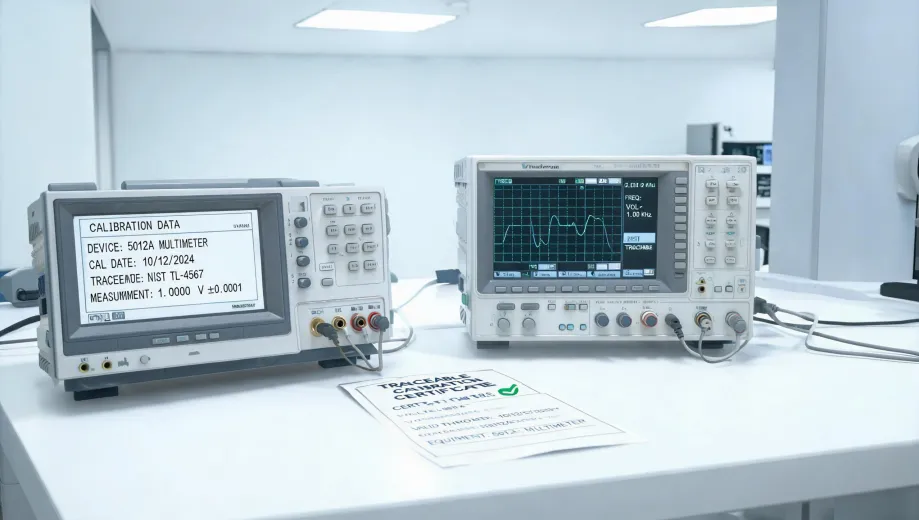
Bench meters often require annual calibration (NIST-traceable). Module-based DMMs in PXI chassis can sometimes be calibrated in-house with a calibration reference, reducing downtime.
Checkpoint: Ask the vendor: Does the module support internal or self-calibration? What's the recommended calibration interval? What's the cost of a standard calibration vs. an accredited cert?
I audited our 2024 calibration spend and found that 6 field-service meters cost us $1,200/year in external calibration fees. Our 3 modular DMM channels cost $150 total (for the reference). That's an 87.5% savings on calibration alone.
Step 5: Future-Proof for Mixed-Signal Systems
If you're working in a system that already includes oscilloscope, thermocouple, or data-logger functions, a modular DMM is often cheaper to integrate than a standalone.
Checkpoint: Will this DMM need to trigger from or synchronize with a data acquisition card, signal generator, or switch in the future? If yes, choose a module that shares the same chassis backplane and timing engine.
The surprise wasn't the price of adding a second DMM module later—it was how much the wiring, synchronization, and software integration cost when we added a standalone meter to an existing system. That cost was nearly $1,000 per meter in additional I/O and programming. A second module in the chassis was plug-and-play.
Common Mistakes to Avoid
- Buying based on lowest sticker price without checking driver availability. The savings from a $200 cheaper meter disappear if it takes 10 hours to program in LabVIEW.
- Ignoring the form factor. A benchtop meter takes up bench space and usually requires manual operation. A module slots into a chassis that may already have other instruments—zero extra footprint.
- Assuming 'multimeter' means the same thing across vendors. NI's digital multimeter modules often include additional functions like diode test, frequency measurement, and temperature measurement (via thermocouple), which can eliminate the need for separate instruments.
One more thing: The fundamentals of measurement accuracy haven't changed—a 6.5-digit meter still measures to 1µV resolution. But the execution has transformed. The best approach in 2025 is not picking the cheapest box; it's picking the one that fits into your software and system architecture without hidden integration costs.