-
Who This Checklist Is For
-
The 5-Step Checklist
-
Step 1: Verify Connector Types Before You Click 'Buy'
-
Step 2: Match Your Signal Type to the Module's Input Architecture
-
Step 3: Check the Module's 'Move Up' Path (Reserve vs. Software)
-
Step 4: Confirm the Chassis Slot Type and Power Budget
-
Step 5: Add a 'Calibration Check' Step to Your Receiving Process
-
Step 1: Verify Connector Types Before You Click 'Buy'
-
Last Thing: The True Cost of Skipping Steps
Who This Checklist Is For
You're wiring a test rig. You've got a National Instruments DAQ module on your bench. You need it to work. First time. This checklist is for anyone handling NI hardware orders — whether you're a junior engineer or a lab manager. It's not about theory. It's about the 5 mistakes I made. Repeatedly.
I've been handling DAQ orders for 6 years. I've personally made (and documented) 18 significant mistakes, totaling roughly $27,000 in wasted budget. Now I maintain our team's checklist to prevent others from repeating my errors. This is it.
The 5-Step Checklist
Step 1: Verify Connector Types Before You Click 'Buy'
Sounds obvious. It's not. In my first year (2018), I ordered a NI 9211 thermocouple module. Four channels. Perfect for what we needed. Except I didn't check the connector type. I assumed green screw terminals — my thermocouples had bare wires. I was wrong. The NI 9211 I bought had a 10-pin mini-DIN input. (Yes, that's a thing, and yes, I found out the hard way when the shipment arrived.)
What to do: Look at the datasheet for the module's I/O connector type. NI modules use: BNC, screw terminal, D-Sub, mini-DIN, MXI, or proprietary connectors. Don't assume. Open the PDF. Check the 'Connectivity' section.
Checkpoint: Does your cable end match the module's connector? If not, add a cable adapter to your cart.
Step 2: Match Your Signal Type to the Module's Input Architecture
Normal people think: 'It's a DAQ module, it measures voltage.' That's true in the same way a car 'goes forward'. But the architecture matters. A lot.
The mistake I made in September 2022: I bought a NI 9205 (32-channel, ±10V, single-ended) for a set of differential accelerometer signals. The accelerometers had amplified outputs, so I saw good levels. The problem? Single-ended mode on that module means you lose common-mode rejection. My readings were noisy. Really noisy. The signal looked like a mess of 60 Hz hum. (Everything I'd read about single-ended vs differential said 'it only matters for low-level signals.' In practice, even with decent signal strength, single-ended was unreliable in our electrically noisy factory.)
What to do: Know whether your sensor needs single-ended, differential, or pseudo-differential inputs. Check the module's datasheet for the available configurations (many NI modules support multiple modes).
Checkpoint: Does the module's input architecture match your signal source's output type? Are you prepared for noise if you pick single-ended?
Step 3: Check the Module's 'Move Up' Path (Reserve vs. Software)
This one caught me in Q1 2024. I ordered a NI 9220 for a chassis that only ran the NI-RIO driver. The module supported the technology fine — compatible hardware. But I missed one detail: the module I bought required a 'reserve' software license to use all its channels at full speed. The base driver only supported lower sample rates. (The conventional wisdom is that hardware compatibility is what matters. My experience with NI's software licensing suggests otherwise.)
The result? I could only use 4 of my 8 channels at the needed rate for a $3,200 order. The fix required buying a second module and a more expensive software tier. $4,800 later, I learned my lesson.
What to do: Before buying, check the module's 'Software Requirements' on the NI website. Look for 'Recommended Software' and 'Driver Compatibility' notes. Search for the module model + 'software license requirement' on forums.
Checkpoint: Do you have the right LabVIEW version, NI-DAQmx version, or other driver to fully utilize the module's features?
Step 4: Confirm the Chassis Slot Type and Power Budget
Most people stop after checking physical dimensions. But for PXI and CompactDAQ systems, the chassis matters as much as the module. I once ordered a NI 9214 thermocouple module for a PXIe-1071 chassis. The module fit physically. But the PXIe-1071 doesn't provide the PXI Hybrid Slot that the NI 9214 requires for PXI. (Hybrid Slots can accept PXI Express modules in the same slot as PXI modules — but some older chassis don't have them.) The module wouldn't even power up.
What to do: Check the chassis manual's 'Slot Configuration' section. Look for a diagram showing compatible module types for each slot. Also, calculate your total power consumption from all modules against the chassis's power supply rating.
Checkpoint: Does your chassis have compatible slots? Can it supply enough power (total current on +5V and +3.3V rails) for all plugged-in modules?
Step 5: Add a 'Calibration Check' Step to Your Receiving Process
I started doing this after the third rejection in Q1 2024. A customer sent back a batch of calibrated accelerometers because our NI 9234 module had drifted 2% out of spec. We didn't catch it during receiving because we hadn't verified the module's calibration status. The drift caused inaccurate test data for a 3-day production run. Rework cost: $8,000.
Now, every new NI module gets a calibration check within the first week.
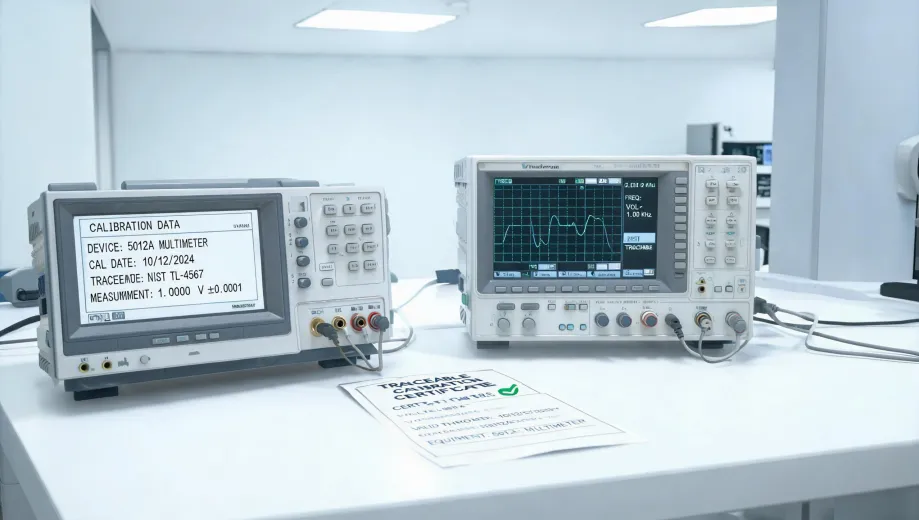
What to do: Before deploying a new module, test it against a known-good reference signal. Track the as-found data. Compare it to the module's published accuracy spec. This isn't a one-time check; implement a regular calibration schedule based on your quality standards.
Checkpoint: Is the module's calibration within its interval? Do you have a documented procedure for as-found verification?
Last Thing: The True Cost of Skipping Steps
I built this checklist because the cost of prevention is way less than the cost of correction. 5 minutes of upfront checking can save 5 days of debugging, 5 weeks of production delays, or $10,000 in replacement hardware. But the biggest cost isn't money — it's credibility. When you tell a customer their test results are compromised because you ordered the wrong connector, trust breaks. That takes longer to fix than any hardware swap.
This information was accurate as of early 2025. NI's product lines and software licensing evolve, so always verify current compatibility on their official documentation before making a purchase.