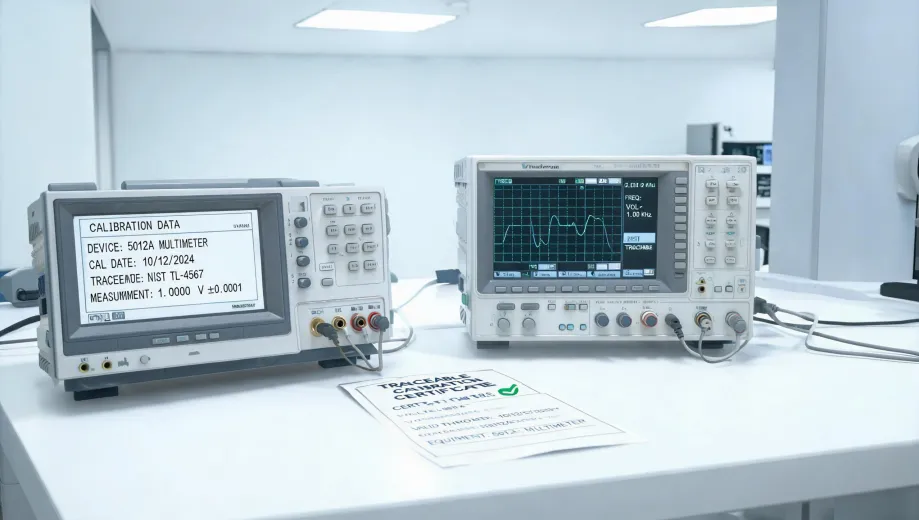
I'll be honest: when I first connected a National Instruments oscilloscope module to a motor drive signal, I expected every waveform to look clean. It didn't. The scope was fine. The setup wasn't. That confusion—thinking the instrument was broken when the system was the problem—cost me $3,200 and a week of credibility.
If you've ever wondered why your digital micrometer readings don't repeat, why the so-called best multimeter for automotive still gives you strange parasitic drain numbers, or why your megger insulation tester says "good" one day and "fail" the next, this is for you.
Your instrument is not the measurement system. It's one part of it.
The Problem You Probably Think You Have
We like to blame the device. I spent a year telling myself I needed a higher resolution meter and a faster scope. More digits always felt safer. In reality, the cheap meter and the expensive meter were both giving me numbers I didn't understand. The difference was how I connected them and interpreted the readings.
It's tempting to think you can compare spec sheets and trust the resulting numbers. That advice, though, is a trap. Identical specifications can behave differently because of leads, grounding, input impedance, and the circuit you're testing. The instrument doesn't live in a vacuum.
The Deep Causes
Ground Loops and Reference Paths
When I first used a National Instruments oscilloscope module, I saw a 60 Hz hum on what should have been a DC signal. My first instinct was to blame the module. It wasn't the module. It was a ground loop. The ground clips were creating a second path back to the power supply, and the hum was the difference between those two paths.
I moved the ground clip to a single-point star ground, and the hum disappeared. It was always us, not the instrument.
That's the first lesson: every scope measurement is just the voltage between the probe tip and the ground reference. If that reference isn't what you think it is, the trace is a story with a false narrator.
Burden Voltage in Multimeters
If you search for the best multimeter for automotive, you'll see ratings like counts and accuracy. But for current measurements, the hidden spec is burden voltage. The meter's internal shunt resistor drops voltage as current flows through it. On some meters, that drop is enough to wake up modules in a modern car or make a fuel pump run slower. You end up measuring a circuit that isn't behaving normally.
You repeat the test with a clamp meter and suddenly the circuit works. The readings are different. Which one is right? Both are right under different conditions. That's the problem: the measurement changed the system.
Here's the thing: "best" is meaningless without understanding your measurement's interaction with the circuit.
A Digital Micrometer Measures More Than the Part
A digital micrometer with 0.0001 inch resolution is a beautiful tool. But it doesn't just measure the part. It measures the distance between two contact faces under a certain force and temperature. Your hand warms the frame. The part cools down on a granite surface plate. The pressure changes when you're rushing. All those factors show up in the display.
We had a part that measured 0.5005 inch in the morning and 0.5012 in the afternoon. The part wasn't changing. The workshop temperature was. The micrometer was working exactly as designed—resolution is not the same as repeatability.
Megger Insulation Testing Is a Process, Not a Button
If you're looking up how to use megger insulation tester, please know this: it is not a big Ohmmeter. It applies a high voltage between conductors and then measures tiny leakage currents through insulation. That voltage stresses the insulation on purpose. You need to choose the correct test voltage, and you need to let the reading stabilize—a one-second "tap" doesn't show you absorption current.
And after the test, the cable is charged. You must discharge it before touching it. I know because I've seen a technician get a jolt from a motor winding. He was okay, but the rule now lives in our checklist: after any insulation test, discharge the device before you disconnect.
The Real Cost of Bad Measurements
In my first year (2017), I checked a controller output with a multimeter set to DC volts. It read 10.2 V. I told the team the signal was good. Then we connected the PLC input card, and the signal collapsed. The analog input card loaded the circuit more than my meter did. I not only missed the real problem, I bought the wrong replacement parts and turned a two-day troubleshooting job into a ten-day repair.
The invoice for replacement parts came to $3,200. The schedule slip was worse. My boss had to hear me say, "The meter was lying to me." No. I mean, I was lying to myself.
In September 2022, a temperature drift issue with the digital micrometer gave us a batch of machined parts that were out of spec. The inspector caught it because his gauge disagreed with ours. The rework cost more than the parts. That's when I started writing down every precondition for every measurement tool in the shop.
Since then, our checklist has caught 47 potential errors before they reached the shop floor.
A Smarter Way: Systems Over Boxes
What finally helped wasn't one fancy instrument. It was connecting instruments to a coordinated platform and making the measurement chain visible. That's where National Instruments modular approach changed things for me. With a PXI or CompactDAQ system, you can configure the front end, set input limits, document gain and offset, and see the whole signal path in one software environment. The National Instruments oscilloscope modules are part of that ecosystem—not because they magically cancel noise, but because they force you to think about ranges, references, and scale up front.
As of January 2025, our lab calibrations follow ISO/IEC 17025, and every critical instrument has a NIST-traceable certificate. NI's own measurement documentation makes the same point: accuracy is not a single spec. It depends on the source impedance, offset error, gain error, temperature, and the wiring in front of the device.
But I'm not going to tell you this is the only answer. It isn't. If you're a field technician doing motor checks all day, a handheld megohmmeter and a quality automotive multimeter are often the right tools. If you're building automated test racks with hundreds of synchronized channels, a modular platform makes sense. This worked for us because we needed synchronized data across 16 plus channels and a documented audit trail. If you're troubleshooting one signal at a time, the same investment is overkill.
Even after we bought the PXI system, I spent two weeks asking myself if we'd made a mistake. Then we ran a 16-channel thermal test with CSV logging and calibrated sensors. The standalone scopes we used before couldn't have done that cleanly. I stopped second-guessing. Not because the hardware was expensive, but because the method was finally systematic.
A Pre-Measurement Checklist
Here's what I wish someone had handed me in 2017. Before you turn on any instrument, walk through this:
- Calibration: Is the instrument within its calibration date? Do you have the certificate and uncertainty statement?
- Ground and reference: For scope or DAQ measurements, where is the return path? Is there a ground loop?
- Burden voltage: For current measurements, what is the meter's burden voltage? Can the circuit tolerate it?
- Temperature and technique: For a digital micrometer or any precision measurement, has the part thermally stabilized? Is the pressure constant?
- Megger parameters: For insulation testing, is the test voltage right for the cable rating? Is the circuit isolated? Do you have a discharge plan?
The Bottom Line
You don't need to buy a new instrument every time a measurement looks crazy. You need to step back and look at the whole system: the probe, the leads, the ground, the range, the operator, the environment. That's why National Instruments has been a useful partner for us—not because the hardware is magical, but because the platform makes the whole chain explicit.
There is no single best multimeter for automotive that fixes bad test leads. No digital micrometer can correct an impatient operator. No megger insulation tester can teach you to discharge the cable. The discipline is in the process, not the box.
It took me five years and a $3,200 mistake to understand that. Hopefully this article saves you the invoice. That's it.