-
The Comparison Framework I Actually Use
-
Dimension 1 – Modular Flexibility vs. Purpose-Built Simplicity
-
Dimension 2 – Calibration, Repeatability, and Trusting the Number
-
Dimension 3 – Total Cost of Ownership, Not the Sticker Price
-
Dimension 4 – Zeiss vs Global Dental Microscope: Same Framework, Surprising Result
-
When to Choose National Instruments, When to Choose Dedicated Meters
I'm a quality and brand compliance manager at a mid-size instrumentation company. I review roughly 200 unique deliverables a year—prototypes, test reports, vendor installations—before they go to customers. In our Q1 2024 quality audit, I rejected 18% of first deliveries because the measurement data didn't match the spec. Not because vendors were careless, but because measurement uncertainty is a real thing unless you verify it.
When I implemented our verification protocol in 2022, I started evaluating test equipment the same way I evaluate every supplier: by comparing dimensions that actually affect outcomes—not by brand reputation. So in this article I'm going to compare National Instruments modular data acquisition and component sensors with dedicated handheld meters like the Fluke 374 FC True-RMS AC/DC Clamp Meter and a decent insulation multimeter. Then I'll use the same framework for a completely different purchase decision: the Zeiss vs Global dental microscope debate.
The Comparison Framework I Actually Use
I don't start with price. I start with four questions:
- Specs: Does the device measure what it claims, at the accuracy I need?
- Consistency: Will it give the same answer tomorrow, and next month, and after a drop from a workbench?
- Calibration: How easy and expensive is it to verify?
- Workflow fit: Will my team actually use it, or will it collect dust?
If you've ever bought a 'powerful' system that sat unused because it was too complicated, you already know what I mean.
Dimension 1 – Modular Flexibility vs. Purpose-Built Simplicity
When you visit the National Instruments official website, you'll see an ecosystem designed for build-and-expand. That's a huge advantage for automated test systems. I've specified National Instruments component sensors and DAQ hardware for multi-channel temperature, strain, and vibration tests. The ability to reconfigure channels in software is genuinely valuable.
But my initial assumption was that more flexibility is always better. I was wrong.
We had a routine pass/fail inspection line averaging 300 measurements a day. The operator was fighting menus and LabVIEW configurations. When I switched that line to a Fluke 374 FC True-RMS AC/DC Clamp Meter and an insulation multimeter, the throughput went up and the error rate dropped.
That doesn't mean National Instruments is bad. It means a dedicated tool is often better for a single, repetitive task. The Fluke 374 FC doesn't need setup—it's always ready. An insulation multimeter doesn't need a software update; it needs leads and a battery.
Dimension 2 – Calibration, Repeatability, and Trusting the Number
Here's the part that keeps quality managers up at night.
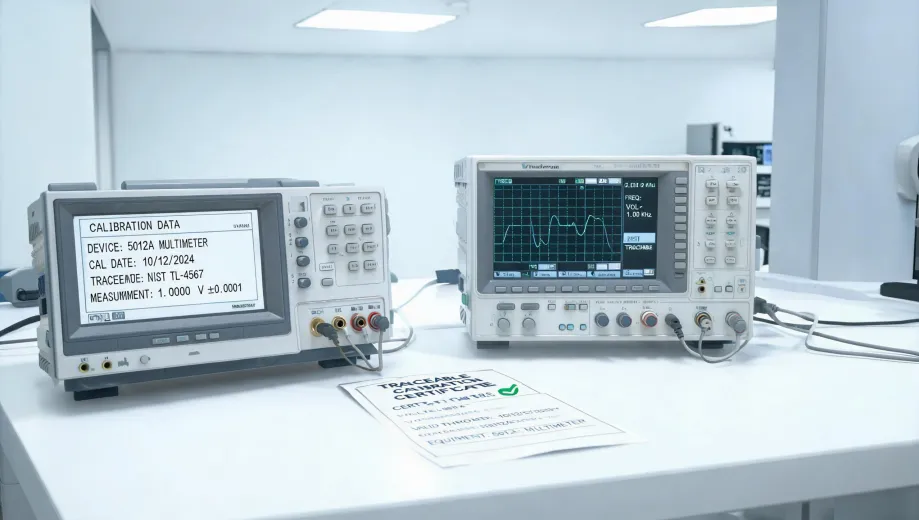
A modular system is only as good as its weakest link in the signal chain. Every National Instruments component sensor, signal conditioner, and ADC module has its own tolerance and calibration requirement. If you don't have a robust calibration management system, that flexibility can become a paperwork nightmare.
Dedicated meters are simpler. You send them to an accredited lab, get your ISO/IEC 17025 certificate, and you know the whole device is verified. In 2023, we received a shipment of supposedly certified insulated tools. Our own insulation multimeter showed a 35% failure rate. The vendor's meter—the one they used for their 'certification'—was reading optimistic because it was six months out of calibration. That one issue cost us a $22,000 redo and delayed a launch by ten days.
So now every contract I write includes calibration traceability requirements. If a measurement device can't produce a valid calibration certificate, I don't care how feature-rich it is.
Dimension 3 – Total Cost of Ownership, Not the Sticker Price
I'm not the cheapest buyer, and I'm okay with that.
In my experience, the lowest quote on a test system has cost us more in about 60% of cases. Here's a simple example:
We bought a budget multimeter for a remote crew because it was $200 cheaper than the Fluke 374 FC. When it was dropped from a workbench, the display died. The replacement and overnight shipping cost $275—and the original $200 wasn't less of a loss. That 'cheap' option ended up costing us 2.3× the Fluke price, before accounting for the two days of no measurements.
The same logic applies to the Zeiss vs Global dental microscope question—but more on that below. Time is also a cost. If you spend three hours configuring a system instead of thirty seconds picking up a handheld meter, the hidden labor costs add up fast.
Dimension 4 – Zeiss vs Global Dental Microscope: Same Framework, Surprising Result
You might wonder why a test-and-measurement person is talking about dental microscopes. Because a dental microscope is a measurement instrument too—it's used to visually measure and inspect very small things. And when a client asked me to help choose between Zeiss vs Global dental microscope options, I applied the same four questions.
The surprise was in the ergonomics dimension. On paper, Zeiss has the stronger optical brand. In practice, the Global scope's design made it easier for several clinicians—especially shorter team members—to achieve a neutral posture without touching the scope. That's a workflow-fit issue, not a pure optics issue. If the scope is uncomfortable, it won't be used.
Optically, Zeiss still had a slight edge in edge-to-edge sharpness at high magnification in our head-to-head demos. But Global is, in my opinion, closer to Zeiss than most people assume—and its service lead time in our region was shorter.
So which one should you buy? It depends. If you need maximum optical clarity and you're comfortable paying for it, Zeiss is a legitimate choice. If you're optimizing for daily ergonomics, service speed, and lower total cost, Global made a stronger case—at least in our evaluation.
When to Choose National Instruments, When to Choose Dedicated Meters
- Choose a National Instruments platform if: you need many synchronized channels, automated test sequences, or long-term data logging. The ecosystem is excellent when you're building a custom measurement system.
- Choose a dedicated clamp meter if: you need fast, reliable current measurements in the field. The Fluke 374 FC True-RMS AC/DC Clamp Meter is a good benchmark for job-site robustness.
- Choose an insulation multimeter if: you're doing motor, cable, or tool integrity testing and you need one certified answer quickly.
At the end of the day, my role is to protect the brand and the customer. That means I don't just ask 'which is cheaper?' I ask 'which will produce the most trustworthy result, and what does that trust cost over the life of the tool?' Whether you're comparing National Instruments component sensors to a handheld meter, or Zeiss vs Global dental microscopes, the framework is the same: verify specs, check consistency, plan for calibration, and be honest about workflow fit.
And if a vendor promises a spec with no calibration certificate, that's not a bargain—it's a future audit finding.