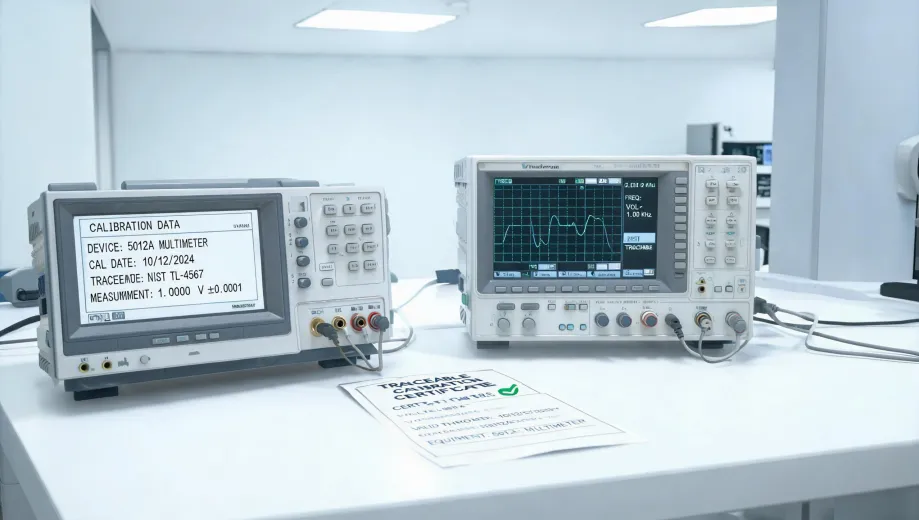
Calibration is never just calibration. Whether you're building a National Instruments (NI) data acquisition system or answering the search query 'how to calibrate Eppendorf pipette,' the unplanned costs come from the same place: unstated prerequisites. Over my career, those prerequisites added roughly $27,000 to my test-station budgets. If a calibration quote doesn't itemize what's included, assume something important is missing.
I was reminded of this recently while reviewing a client's proposed setup. They chose an NI PXI chassis, a couple of modules, and LabVIEW. The budget looked fine until I noticed the line for 'sensor calibration' was blank. When I asked what they'd do with the thermocouples and RTDs, they said, 'we'll calibrate the module, that's enough.' No. The module can be perfectly calibrated and still report a wrong value if the sensor has drifted.
Why trust this
I'm a principal test engineer at a contract test-development company. For 12 years, I've specified systems that combine National Instruments hardware with lab instruments: Eppendorf centrifuges, digimatic calipers, balances, and the occasional 5430 centrifuge. I've made six significant budgeting mistakes that are documented. They add up to roughly $27,000 of wasted budget, not counting the delays. I maintain our team's pre-purchase checklist now, and the calibration cascade is the reason.
The calibration cascade
Every measurement has links: sensor, cable, signal conditioning, analog-to-digital converter, software scaling, and the reference used to verify the reading. If you calibrate one link and ignore the others, you're guessing. The cascade effect is why separate calibrations don't add up to one trustworthy system.
Here's the counterintuitive part: separate calibrations are often worse than one end-to-end calibration. With two separate reports, you combine two uncertainty budgets and you still haven't tested the cable. With a system-level calibration, you apply a known stimulus at the sensor tip and read the result through the whole chain. You get one number. In my experience, that's tighter and usually cheaper.
National Instruments component sensors
When I say National Instruments component sensors, I mean transducers that plug into a National Instruments DAQ system—thermocouples, RTDs, load cells, accelerometers. The module's calibration certificate doesn't cover the sensor. If a load cell has been overloaded, no module calibration will catch it.
In 2017, I ordered a 16-channel thermocouple module and cheap probes from a supply house. I paid for module calibration and assumed probes were 'fine because new.' They weren't. The first audit reading was 2.1°C off. The customer caught it. $1,100 in rework and a week's delay later, I still kick myself for not asking for a system-level check.
The digimatic caliper and the 'small' integration
Another classic: we used a digimatic caliper for incoming inspection and recorded measurements by hand. When we automated with LabVIEW, I didn't budget for reading the caliper directly. After a month, someone asked why we were still typing numbers. The cable was under $100, and the driver integration (which, honestly, should have taken an hour) took most of a day because the pinout was odd and the LabVIEW example didn't match our version. The lesson: before you buy any instrument, check the National Instruments downloads page for a compatible driver and prove it works before the system is finished.
The 5430 centrifuge temperature check
For a pharmaceutical QC station, we integrated an Eppendorf 5430 centrifuge into an automated sample-prep workflow. The factory speed test looked okay, but the site protocol required a temperature verification at 4°C with a calibrated probe in a rotor chamber. We had a probe, but its certificate had expired a week earlier. That one expired certificate caused a $400 re-run and a three-day slip. Now 'what's verifying the reference?' goes on every checklist.
How to calibrate Eppendorf pipette (the honest answer)
The phrase that drives search traffic is 'how to calibrate Eppendorf pipette.' It sounds simple: dispense water, weigh it, look up the volume. In practice, you need a balance with proper readability, an evaporation trap, stable room temperature, documented water temperature, and a person with repeatable technique. We built that setup once and then found our balance's calibration certificate had expired. We calibrated the balance, then the pipette. The pipette passed. The process, on the other hand, cost a week of labor. No one budgets for the reference chain.
What I do now
I now structure every calibration budget around the measurement chain, not individual devices. For each channel, I write down every link and ask who owns it.
- Reference traceability. Is the thing you use to verify the measurement calibrated, and is its certificate current?
- End-to-end verification. Can you apply a known input at the sensor tip and see the expected value in LabVIEW?
- Driver compatibility. Does the instrument's driver work with your current NI software? Check the National Instruments downloads page before you buy.
- Documentation. What audit-ready report do you need? Write it into the purchase order.
I've learned to ask 'what's not included' before 'what's the price.' The vendor who lists all calibration fees upfront—even if the total looks higher—usually costs less in the end. Transparent pricing is a trust signal, not a luxury.
Where this advice doesn't apply
If you're doing flight-certification or clinical diagnostic work, you have metrology requirements that go beyond this checklist. This is not a substitute for your quality system. My experience is based on about forty test stations in medical device and industrial labs, not high-channel-count aerospace arrays. The cascade only gets more complex with more channels.
One more caveat: as of early 2025, National Instruments downloads and calibration service lead times change. Verify current software versions and service schedules before you commit to a deadline. The structure of the problem won't change much, but the specifics will.