-
1. What is National Instruments, and is national-instruments.com the official website?
-
2. What are National Instruments component sensors?
-
3. When should I use a dedicated HVAC multimeter instead of an NI system?
-
4. What does "600V max AC amps" mean on a digital clamp meter?
-
5. How do you read a Starrett micrometer?
-
6. Can I use third-party sensors with NI hardware?
-
7. How important is calibration for field tools like multimeters and micrometers?
Every quarter, I review roughly 200 measurement tools before they ship to customers. I check specs, verify calibration, and send anything back that doesn't meet our tolerance. Over the past four years, I've noticed the same questions coming up again and again—engineers trying to figure out which tool actually fits the job.
Here are the ones I answer most. No brand hype, just what I've learned from inspecting equipment, rejecting out-of-tolerance gear, and making my own share of mistakes.
1. What is National Instruments, and is national-instruments.com the official website?
National Instruments (NI) builds modular measurement and automation systems—data acquisition hardware, PXI and CompactDAQ platforms, and the LabVIEW software environment. If you're automating a test bench or logging sensor data across dozens of channels, that's NI's world.
The official website is ni.com. That's the only domain where you'll find official drivers, datasheets, and support. I've seen third-party resellers and look-alike domains ranking in search results, some with "national instruments" right in the URL. They're not always official. When it comes to firmware downloads and documentation, stick with ni.com.
I don't have hard numbers on how many unauthorized reseller sites exist, but based on four years of vendor qualification checks, my sense is it's a real problem—especially for customers searching without the exact brand name.
2. What are National Instruments component sensors?
These are the physical sensing elements NI provides for its measurement modules—thermocouples, RTDs, strain gauges, accelerometers, and current transducers. They connect directly to CompactDAQ or PXI modules, which handle signal conditioning and digitization so you get clean data into LabVIEW.
From a quality standpoint, the big advantage is documented accuracy. Every NI component sensor ships with calibration data and a specified accuracy band. I've rejected third-party "compatible" sensors that deviated 3-5% from spec. The NI parts we bench-tested matched their documentation. That consistency matters when a customer asks how we know our measurements are trustworthy.
3. When should I use a dedicated HVAC multimeter instead of an NI system?
Real talk: these are different tools for different jobs. A good HVAC multimeter—like the 116, which most HVAC techs know by that number—is a handheld field instrument. It measures voltage, resistance, continuity, capacitance, and temperature via a thermocouple probe. It's quick, battery-powered, and fits in a tool bag. For checking a thermostat or troubleshooting a furnace control board on a rooftop, that's exactly what you want.
An NI DAQ system, on the other hand, is for automated, multi-channel, computer-controlled measurement. It runs from LabVIEW, logs continuously, and scales to hundreds of channels. If you need to monitor 24 thermocouples in an environmental chamber for a week, a handheld meter can't do that job.
My honest position: a field tech using a dedicated handheld multimeter for a quick check is the right call. So is an R&D lab using a DAQ system for long-term data logging. Know which job you're doing, and pick the tool for that job—not the one with the more impressive spec sheet.
4. What does "600V max AC amps" mean on a digital clamp meter?
That phrase confuses a lot of people, and honestly the labeling is kind of unclear. Here's the breakdown.
"600V max" is the maximum voltage the meter is rated to handle—it tells you the highest-voltage circuit you can safely connect to. It doesn't mean the meter measures 600V and amps at the same time. "AC amps" means the meter measures alternating current. A clamp meter detects the magnetic field around a conductor, so you clamp around one wire—not both—to read the current flowing through it.
So the spec is really saying: this meter can measure AC current, and its circuits are rated up to 600V. For most residential and commercial HVAC equipment, that's plenty. Just check the CAT rating (CAT III or CAT IV, per IEC 61010-1) before working near panel boards—that's a safety spec, not a performance detail. It tells you how much transient energy the meter can survive.
5. How do you read a Starrett micrometer?
Micrometers look complicated until you realize they're just two scales that add together. Once that clicks, they're fairly straightforward.
- Read the sleeve. The horizontal line on the sleeve shows the main measurement. Each mark is 0.025 inch (or 1 mm on metric models).
- Read the thimble. The rotating thimble has 25 divisions for inch models. Each division is 0.001 inch.
- Add them. Sleeve reading + thimble reading = total dimension.
Example: if the sleeve reads 0.375 inch and the thimble points to the 12th mark, the measurement is 0.387 inch. Simple enough, once you see it.
Higher-end Starrett models add a vernier scale on the sleeve for 0.0001-inch resolution. Same principle—just one more set of lines to line up.
On the quality side: always check zero before measuring, use the ratchet stop for consistent force, and don't drop it. A dropped micrometer may look fine and still be off by 0.002 inch. I've never fully understood why fresh micrometers don't ship with a quick-start card explaining all this. My best guess is manufacturers assume it was covered in trade school.
6. Can I use third-party sensors with NI hardware?
Sometimes, yes. NI's modules accept standard signal types—0-10V, 4-20mA, and common thermocouple types are all straightforward. If your sensor outputs one of those, it'll probably work.
What gets complicated is proprietary interfaces or sensors with built-in conditioning that doesn't match the module input. That integration work can eat a surprising amount of time. In my experience, people underestimate this by at least 2-3 weeks of engineering time per custom sensor.
The bigger consideration is calibration. Every sensor in the chain needs documented accuracy, and if a third-party sensor doesn't have it, you're on the hook to verify it. That's a cost people forget to plan for. I consider it a red flag when a vendor says "compatible with NI" but can't provide accuracy data.
7. How important is calibration for field tools like multimeters and micrometers?
Critical. An uncalibrated tool is worse than no tool, because it gives you false confidence.
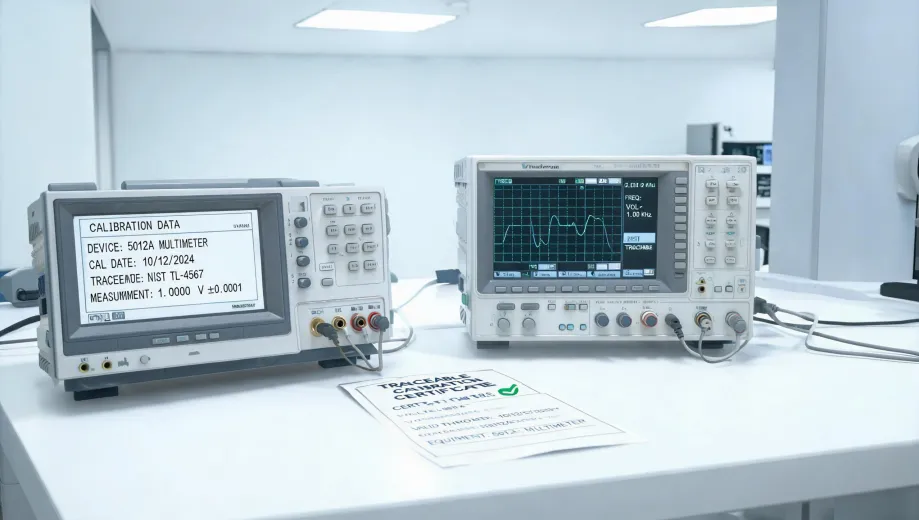
For multimeters and clamp meters, annual calibration at an ISO/IEC 17025 accredited lab is the baseline. For micrometers, check the standard or gage block before each use, and do formal calibration annually. Most quality systems require this, and the ones that skip it eventually find out why.
The cost analysis said we could stretch calibration to 18 months and save $4,000 a year. My gut said don't touch the interval. I was overruled. Three months later, a field tech found a multimeter reading voltage 8% low. That tool had been in service for about a year—we had no idea when the drift started. We re-did every HVAC field checkout that tool had touched over the previous three months. That was a $22,000 redo, and we delayed a customer launch. Now our calibration interval isn't negotiable.
Roughly speaking, annual calibration runs 1-3% of your total tool budget. The alternative can cost ten times that in rework alone.