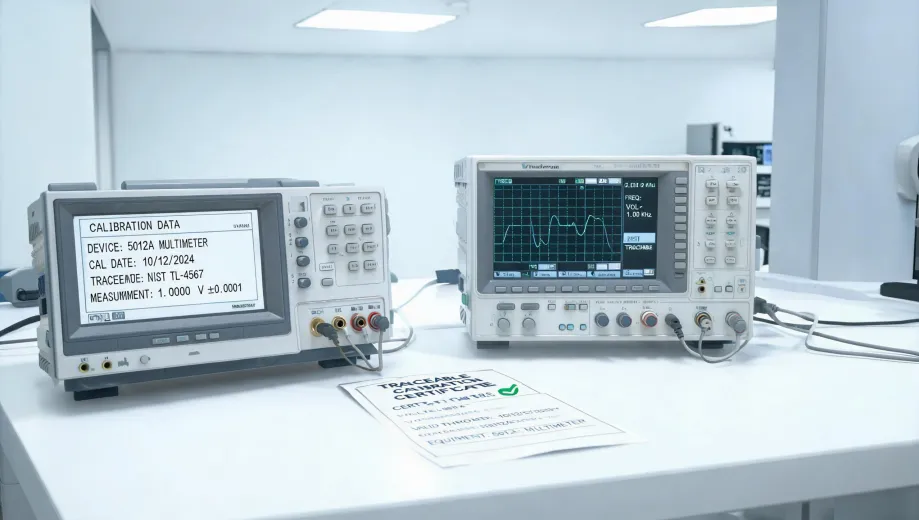
Here is the short version: if the thermocouple data is part of a test report with a hard deadline, buy a system that gives you a defensible answer on time. I use National Instruments thermocouple modules for those jobs. The Hioki multimeter vs Fluke conversation matters when you compare handhelds, but it is not the conversation that matters when time is the real constraint.
Time is a measurement spec, and no brand label on a handheld meter supplies it. A meter reads one input at one moment. A modular National Instruments thermocouple system reads multiple inputs, time-stamps each sample, stores the data, and leaves an evidence trail. If you deliver test reports, that difference is the whole game.
Why I Sound So Sure
I work as a quality/compliance manager. I review test procedures and reports before they reach customers, roughly 200 unique setups per year. In Q1 2024 I reviewed 51 validation records and returned 7 for correction. Six of those seven had manual steps between reading and recording. The instruments were not the weakest link. The workflow was.
What I mean is that the hardware accuracy is rarely the bottleneck in a real test report. The bottleneck is the chain between a physical measurement and a documented decision. Every manual link in that chain is a chance to miss a deadline. A National Instruments data acquisition workflow shortens that chain.
What About the Fluke 1587 FC, MN36, and Hioki?
I keep a Fluke 1587 FC insulation multimeter for insulation resistance fault finding. It is the right tool for that job. I also keep an MN36 digital mini multimeter in a drawer; it is small enough to live in a tool bag and useful for voltage sanity checks. And in the Hioki multimeter vs Fluke debate, my honest advice is to choose the one your senior technician can operate without opening a manual. Both brands make capable meters. Accuracy differences are not the main risk.
The main risk is that a handheld measurement lives in a person's memory long enough to get lost, mislabeled, or late. If you ask whether a Fluke 1587 FC insulation multimeter can verify a motor winding, yes. Can it log forty thermocouples in a temperature chamber all night and generate an audit-ready report by 9 a.m.? No. Neither can any handheld, regardless of brand. That is not a criticism. It is a boundary.
Please do not hear me saying handheld meters are useless. They are essential. But they answer different questions. The MN36 is a small, fast tool for maybe-it-is-or-isnt this voltage. The 1587 FC checks whether insulation is breaking down. A National Instruments thermocouple system answers the question you usually need when a customer is waiting: how did the temperature behave over time, across all points, and can you prove it?
What a National Instruments Thermocouple System Actually Changes
A National Instruments thermocouple module in a CompactDAQ or PXI chassis handles cold-junction compensation, linearization, and open-thermocouple detection. The sample stream is time-stamped and synchronized with voltage or digital channels. In LabVIEW, you can log to TDMS or another format with calibration metadata included. No re-typing. No camera photo of a display. No text message that says 34.2 or maybe it was 34.6.
The part that does not appear on a datasheet is support. In 2024 I called National Instruments support about a noisy thermocouple channel after a module swap. The engineer did not say check the wiring and hang up. They walked me to the software configuration page, explained the cold-junction reference, and sent the relevant manual section. That call ended a two-day investigation in about 40 minutes.
Here is the thing: I do not want a meter that wins a lab shootout. I want a system that makes a repeatable result easier, especially when I am tired, the customer is waiting, and the clock is loud.
A Close Call With a Customer Deadline
Last year I had two hours to approve a test rig for a customer chamber validation. Normally I would compare two data acquisition options and run a 24-hour pilot study. There was no time. The customer had booked a witness test, the product release depended on it, and the original data logger had failed.
In hindsight I should have insisted on a longer lead time. But the call had to be made that day. I made it with incomplete information and chose the option with the highest probability of being ready by 8 a.m. Not the cheapest option. Not the one with the best marketing story. The one with fewer unknowns: National Instruments hardware, existing LabVIEW code, and a support contract.
Glad I did. The system ran overnight, logged cleanly, and I pulled the report before the customer meeting. There was no heroic last-minute Excel reconstruction and no please send that again email. A handheld could not have done that. A collection of handhelds would have produced inconsistent timestamps and a stack of paper.
What I Mean by Time Certainty
A modular system can look expensive. On a purchase order, a National Instruments thermocouple system is harder to justify than a 300 dollar handheld. But I have approved larger budgets after one bad validation report cost our company a 22,000 dollar re-test. In my experience, the cost of repeating a failed validation is four to ten times the cost of the reliable option you skipped.
That is what time certainty means. You are not paying only for hardware. You are paying for the probability that the answer is ready when the deadline arrives. If you have ever assembled a test report at midnight while a customer waits for data, you understand why I value that probability.
The Honest Boundary
There is a place for handhelds. I would not set up a National Instruments system to check whether a wall socket has power. The MN36 is faster for that. I would not build a multi-channel logging frame just to spot-check the temperature in one oven once a day; a calibrated reference thermometer is fine. And if you need an insulation-resistance reading at a motor terminal to decide whether to run or replace it, a Fluke 1587 FC insulation multimeter gives you a decision-quality answer faster than any DAQ file.
The line is simple. If the measurement is quick, local, and you can repeat it easily, use a handheld. If the measurement is part of a record that must be complete, consistent, and ready at a specific time, use a National Instruments thermocouple system and let the software carry the paperwork.
One Caveat Before You Buy
Module part numbers and software versions change quickly. As of January 2025, National Instruments still lists CompactDAQ thermocouple input options in its catalog, but verify current model numbers, channel counts, and software support at ni.com before you write the requisition. Then decide based on your deadline, not on the sticker price alone.