-
Why a checklist?
-
The 7-Point Checklist
-
1. Start at the National Instruments official website
-
2. Build a total cost model, not just a price comparison
-
3. Plan the National Instruments download before the hardware arrives
-
4. Decide whether you need specialized tools like a 771 milliamp process clamp meter
-
5. Add multimeter test leads and other consumables to the BOM
-
6. Compare like with like (Topdon vs FLIR thermal camera example)
-
7. Plan calibration and first-article verification before you install
-
1. Start at the National Instruments official website
-
Final warnings I'll leave you with
If you're the person who signs off on test equipment, you know the feeling. A requisition comes in for a National Instruments DAQ system, and you look at the price. Then, by the time the cables, software, and calibration show up, the project is 20% higher than the quote. I'm a procurement manager at a 120-person automation company, and I've overseen about $180,000 in test-and-measurement spending over the past six years. This is the seven-point checklist I use before I approve any National Instruments purchase.
This is not a general "make sure it works" list. Every item below has caught a real cost or a real delay in our process. Some are things you already expect. One or two are things people only discover after the hardware arrives.
Why a checklist?
It took me about three years and 80 purchase orders to understand that checklists aren't just paperwork. They're the cheapest insurance you can buy. In the test-and-measurement world, a 15-minute check now beats a 3-week rework later. From the outside, it looks like a purchase order is a purchase order. What you don't see is the time spent after a wrong part arrives, waiting for a return authorization, then waiting for the right part.
Here's the structure I use. It's not the only one, but it has worked for us.
The 7-Point Checklist
1. Start at the National Instruments official website
Before you look at any distributor quote, go to ni.com. That's the National Instruments official website. I know the URL doesn't look fancy. It's still the fastest way to verify a part number.
A few years ago, we received a quote for an NI-9205 module at a price about 30% above the standard. The quote's part number had an extra suffix. When I checked the official website, that suffix didn't exist. The real module cost less. The quote also lacked the connector block. I almost signed it because the rep had been friendly.
Now the rule is simple: any part number on a quote must match ni.com. If it doesn't, the quote is incomplete, a different revision, or a mistake.
2. Build a total cost model, not just a price comparison
The purchase price is maybe 60% of the story. The other 40% is a mix of cables, connectors, software licenses, shipping, duties, calibration, and the time it takes your engineers to configure the device.
In Q2 2024, we compared two quotes for a PXI system. One distributor quoted $14,200 and included all accessories. Another quoted $12,900, but the accessories were listed as line items. When I added them, the second quote was $15,050. That's an $850 difference hidden in the fine print. We went with the first distributor. Our procurement policy now requires three quotes for any capital item over $5,000, because a single quote doesn't have to be wrong to be incomplete.
I keep a TCO spreadsheet for every capital purchase. It has columns for hardware, software, shipping, duties, calibration, and internal labor. "Free setup" is not a line item; it's a phrase that appears before the bill. One vendor offered free setup, then charged us $450 for a "calibration fixture rental" that wasn't mentioned in the quote. We no longer accept "free setup" without a written description of what it includes. Prices in these examples are from our 2024 quotes; verify current rates.
3. Plan the National Instruments download before the hardware arrives
This one sounds too obvious, but it has delayed more projects than any mechanical problem. When you buy NI hardware, you need drivers and often a programming environment. According to the National Instruments download page at ni.com/downloads, most current driver sets are distributed through NI Package Manager. The download page is one of the most important places to check.
Here's the part people ignore: downloading and installing this software in a corporate environment is not a two-minute task. It requires account permissions, IT approval, and sometimes a license file. We once had a $14,000 data acquisition setup sitting on a bench for three days because the engineer who ordered it didn't have the login rights to the National Instruments download portal. The hardware was fine. The process wasn't.
My recommendation: check the National Instruments download page before your PO goes out. Write down which drivers and software versions you need. Then tell your IT team. That way, when the hardware arrives, you can install the software immediately. Downloading the software early is free. Waiting until after the hardware shows up is expensive.
4. Decide whether you need specialized tools like a 771 milliamp process clamp meter
NI hardware is modular, and that's a huge advantage. But it doesn't replace every handheld tool in your toolbox.
If your maintenance team works on 4-20 mA loops, they may need something like a 771 milliamp process clamp meter. That's a specialized tool for measuring loop current without breaking the circuit. It's useful, but you have to plan for it as a separate purchase. NI offers 4-20 mA input modules for data acquisition, but that's a different tool for a different job: continuous logging, not field troubleshooting.
I've made this mistake. We ordered a current input module and told everyone it handled loop testing. It did not, because the technician needed to temporarily disconnect the loop to install the module in the system. The clamp meter would have let them do the test without touching the wiring. We ended up buying one after the fact, plus paying for the technician's second visit. If you're budgeting for process instrumentation work, include the clamp meter as its own line item and train people on when to use it.
5. Add multimeter test leads and other consumables to the BOM
Multimeter test leads are the easiest thing to leave off a bill of materials. They look like a $30 accessory. But they're consumables. In the past five years, we've purchased at least 20 sets. If you buy cheap leads, you'll buy more of them, and you'll also deal with intermittent readings that are hard to diagnose.
This is a prevention-over-cure step. A good set of silicone-insulated test leads costs more upfront, but they last longer and are more flexible in cold labs. The cost difference is often less than one hour of engineering time. For the price of two status meetings, you can equip a bench.
So when you ask for a quote, ask for a complete accessory list. Not just "leads included" but exactly which leads, how many, and whether they are rated for the current you're measuring. If a manufacturer says "test leads sold separately," multiply that cost by the number of stations you have, not the number of devices you're buying today.
6. Compare like with like (Topdon vs FLIR thermal camera example)
This checklist isn't only for National Instruments. I use the same logic when we're buying other test equipment.
Take thermal imaging. If you're weighing a Topdon vs FLIR thermal camera, the headline price and sensor resolution are not the whole story. You have to look at the software, whether the data can be exported to your reporting format, how many images the internal memory can hold, and whether the manufacturer's software updates are free or subscription-based. A camera with a lower price can end up costing more after you buy the software license and the PC connection kit.
In the same way, when I compare NI modules from different suppliers, I make sure the bids include the same options. I don't compare an OEM-level module to a bundled package. It's too easy to say "the competitor is cheaper" when the cheaper version has fewer I/O channels or no terminal block.
7. Plan calibration and first-article verification before you install
The last point on the checklist is the one I care most about, because it's what prevents rework.
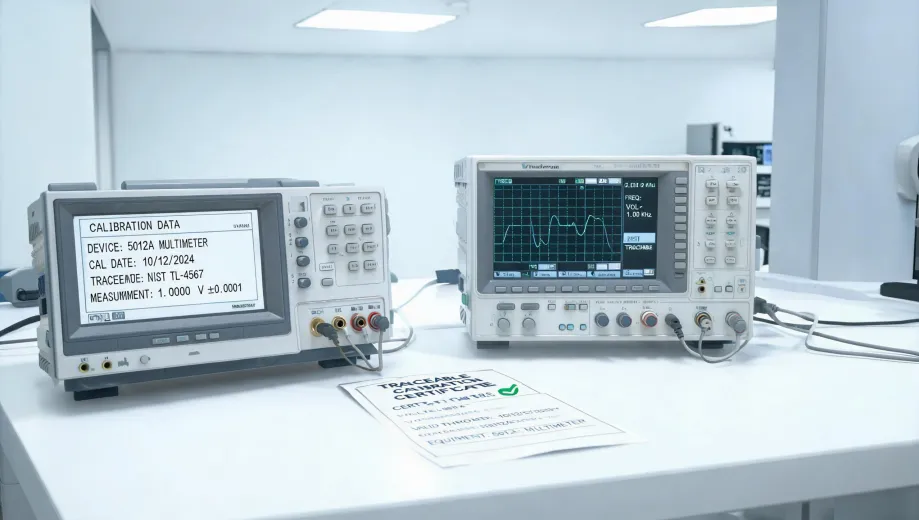
When a new NI module arrives, don't put it in the rack and start collecting data. Plan a first-article check. That means verifying the module's measurements against a known reference or a calibrated source. This takes maybe five minutes for a voltage or current reading. It has saved us from a much longer investigation later.
A few years ago, we received a batch of thermocouple modules. Two of them were out of calibration, which is rare but possible. Because we tested every module at the bench, we caught the problem before the modules were installed in a customer's system. The replacement was straightforward. If we'd installed them without checking, we would have had to tear down the cabling and potentially re-run a week of acceptance tests. I estimate that bench check saved us about $8,000 in labor and fees.
I keep a 12-point acceptance checklist for each type of NI module. It isn't elaborate. It's just a sequence of checks: firmware version, input range configuration, data streaming rate, and a measurement compared to a known source. It takes an hour, at most. That's the cheapest insurance we buy.
Final warnings I'll leave you with
Don't assume that an authorized distributor's quote is always the same as the official website. Check part numbers, included accessories, and software download rights. "Expedited shipping" is often a profit center, not a real cost.
Don't let the phrase "we'll set you up remotely" replace a written installation plan. I've seen that phrase lead to a two-week wait for a time zone that didn't line up.
And don't compare equipment categories the wrong way. The Topdon vs FLIR thermal camera comparison matters if you need thermography, but it's a different product category from a fixed thermal camera for continuous monitoring. Know your application before you shop.
The worst time to find a cost problem is after the purchase order.
A few minutes of clicking through the National Instruments download page, verifying the official website, and adding test leads to the BOM will never feel urgent. It will also never be the reason a project stalls. That's why I do it before, not after.