The Problem You Think You Have
Last November I watched a junior buyer burn most of a Thursday afternoon on something that should have taken twenty minutes: figuring out where to buy a clamp multimeter.
She had the requisition in hand. The spec was clear—CAT III 600V, true RMS, a brand we'd used before. The problem wasn't what to buy. It was where.
The manufacturer's product page had a "buy now" button that redirected to a regional distributor. That distributor listed the meter as "call for pricing." A marketplace search showed the same model at roughly 40% less, shipped by a seller with no storefront history. Another page claimed to be the "official outlet" and offered a bundled calibration certificate of unclear origin.
Four tabs. Four prices. Three different claims about what was actually included.
I review around 200 instrument purchases a year in my role—everything from a handheld oscilloscope to pressure gauges to whichever sensor someone promises will "just drop in." The junior buyer's Thursday is not unusual. The frustration is real, and it usually gets blamed on the wrong thing.
What's Actually Going Wrong
Here's what I've learned after four years of approving purchases and—more painfully—fixing the ones that slipped through. The problem is rarely where. It's what exactly am I buying, and who's standing behind it.
"Official" is doing a lot of work
Most buyers assume that starting at a hexagon official website means they'll end up buying directly from Hexagon. In practice, "official" often means the brand-owned information site, and the actual transaction happens through a shop page, a distributor, or a regional partner.
That's not a trick. It's how B2B instrument distribution works. But it means the word "official" doesn't always tell you which page is the manufacturer's storefront, which is an authorized reseller, and which is a third party that happens to look polished.
This tripped us up early. We followed a hexagon shop link from a partner page and assumed the order went to Hexagon directly. It didn't. It routed to a reseller with different return terms and a longer lead time. Nobody lied to us. We just didn't check who was actually processing the order until the invoice arrived.
The part number trap
I assumed for years that a part number was a part number—same specs, same performance, same condition, wherever you buy it. Didn't verify. Turned out calibration status, firmware revision, and even accessory bundles varied by channel.
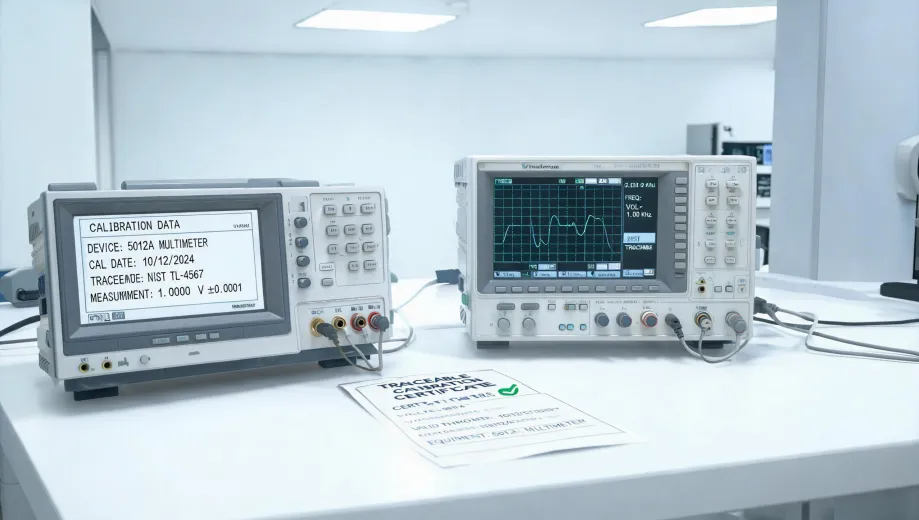
We bought two identical clamp multimeters from two sources within the same month. Same model number on the box. One arrived with a calibration certificate traceable to an accredited lab. The other came with what looked like a spec sheet photocopy labeled "quality certificate." That's when I stopped trusting product pages and started asking a different question: what's in the box, and who signed off on it?
The same thing happens with sensors. A search for where to buy ifm inductive sensors online returns pages that all look like the same product—until you compare what's in the listing. Some include original packaging and a manufacturer warranty card. Others are surplus units pulled from a decommissioned line, with no traceable history at all. The listing doesn't always tell you which one you're getting.
The paperwork is the product
What most people don't realize is that the price difference between two "identical" instruments is almost never about the instrument. It's about the documentation that travels with it—and that documentation is what makes the instrument usable.
NIST's guidance on measurement traceability is blunt about this: calibration records need to establish an unbroken chain back to national standards. ISO/IEC 17025 makes the same demand from the lab side. Traceability isn't a nice-to-have you can retrofit later. If the chain has a gap, the instrument is a liability, not a tool.
We had a batch of pressure gauges arrive with calibration certificates dated three months before shipment. The instruments had been sitting in a warehouse somewhere in between. The cert was technically real. It just didn't describe the state of the instrument that arrived at our dock. We sent them back for re-calibration and ate the delay.
What It Costs When You Skip This
That pressure gauge issue cost us roughly $1,800 in re-calibration and a two-week slip on a customer delivery. Not catastrophic. But it wasn't the first time, and it wasn't the last.
The bigger cost is audit risk. In our Q1 2024 quality audit, two instruments got flagged because the calibration documentation couldn't be verified within the review window. We passed, but only after a week of chasing original certificates from a reseller who had gone quiet.
They warned me about hidden fees with that vendor. I didn't listen. The "cheap" quote ended up costing about 30% more than the one we'd compared it against once shipping, duties, and a replacement calibration certificate were added. We had saved 18% on paper. We paid more in reality, plus two weeks of my time.
I've learned to ask "what's NOT included" before I ask "what's the price." That one change would have saved us most of these headaches.
A Shorter Path
Three things, and then I'll stop.
- Verify the seller, not just the product. Check whether the shop page is the manufacturer's storefront or a reseller. Ask for the exact entity name that will appear on the invoice. This is the question that would have saved us the most trouble.
- Ask what's in the box before you ask what it costs. Calibration certificate? Traceable to whom? Firmware version? Return terms? If a listing can't answer any of those in writing, treat that as the answer.
- Treat "too good to be true" as a question, not a deal. A meter at 40% below market isn't automatically counterfeit, and a clamp multimeter can genuinely be discounted. But the price usually tells you what's been excluded from it.
To be fair, some of this is just the cost of buying instruments online. Channel complexity is real, and I don't think anyone has fully solved it. But the buyers who get burned least are usually the ones who treat the purchase as an audit rather than a transaction.
The junior buyer did eventually place her order. It took two more emails than it should have, and we got written confirmation of the calibration source before she clicked buy. The meter worked fine. The lesson wasn't about the meter—it was about how much we'd been assuming.