The Short Version
If you're buying lab equipment — whether it's a used Tektronix 2445 oscilloscope for the bench, a thermal camera phone attachment for field techs, or an Extech pH meter for water analysis — here's the rule I've settled on after six years: verify the paperwork before you verify the price. A calibration certificate and a proper invoice matter more than 15-20% off the sticker. I learned that the expensive way in 2021, and it has reshaped every purchase order I've signed since.
Concretely, that means three things in practice:
- Instruments with calibration requirements (pH meters, oscilloscopes, thermal imagers): buy from a source that issues a traceable calibration certificate, even when it costs noticeably more than a marketplace listing. ISO/IEC 17025 accreditation is the marker I look for in the vendor's documentation.
- Reusable lab tools (pipette aids, probes, accessories): confirm the return window and whether spare parts exist before the order ships.
- Software or portal access (like a Tektronix login for firmware and warranty records): verify the login actually works before the return window closes, not after.
That's the whole thing. Everything below is why I got there.
Who I Am and Why This Might Be Worth Reading
I'm an office administrator at a 180-person electronics lab. I manage procurement for the engineering and R&D teams — roughly $340,000 annually across 11 vendors, split between consumables, instruments, and a bit of IT hardware. I report to both our operations director and our controller, which means I get squeezed from two sides: engineers want equipment yesterday, finance wants receipts that pass audit.
I took over purchasing in 2020. If I remember correctly, my first full year I processed 68 purchase orders. Last year it was closer to 140. The volume went up; the patience for my mistakes went down. So take the advice below as hard-won rather than theoretical.
The Tektronix 2445 Oscilloscope: What "Tested" Actually Means
In early 2022, one of our senior engineers asked for a bench oscilloscope. He wanted an older analog unit — specifically a Tektronix 2445 oscilloscope — because he had used one in grad school and trusted the front panel. Fine. I found one on a surplus reseller for $380.
The listing said "tested, working condition." I bought it. It arrived, powered on, showed a trace, and everyone was happy for about three weeks. Then the trace started drifting and the engineer opened it up. Two capacitors had leaked. The repair quote was $290.
Here's the thing: the reseller had tested it. But "tested" meant it turned on. It didn't mean it passed a performance verification. That distinction cost us $290 and a month of bench downtime. (Note to self: from now on, "tested" gets defined in writing before I pay.)
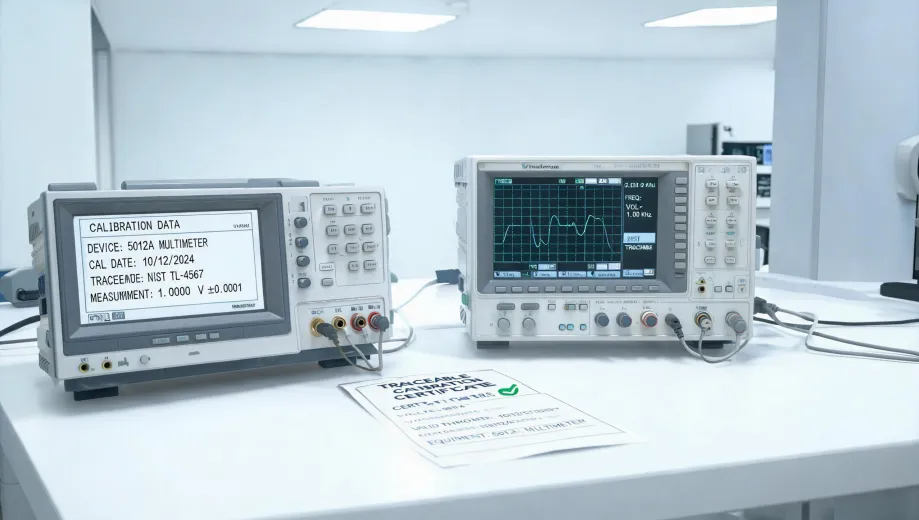
So now, when I buy any instrument — new or used — I ask for one of two things: a calibration certificate from a recognized lab, or a written performance verification report. If the seller can't provide either, I walk. Buying through an authorized channel also gets you registered warranty coverage and Tektronix login access for firmware, service history, and serial number lookups. I use that portal on every scope purchase to confirm the serial matches the warranty record before our 30-day return window closes. It takes five minutes and has caught two mismatches in two years.
The $2,400 Invoice Mistake
Here's the one that actually hurt. Late 2021. A new vendor quoted us on a batch of lab consumables — pipette tips, tube racks, and a couple of pipette aids (the motorized controllers that fit on top of a serological pipette and let you aspirate without your thumb). Their price was about 18% below our regular supplier. Total order: $2,400.
I knew I should verify their invoicing setup first. But I thought "what are the odds?" We'd exchanged four emails, they seemed legitimate. Well, the odds caught up with me. The shipment arrived with a handwritten receipt — no VAT number, no purchase order reference, nothing finance could process. The expense report got rejected. I had to eat $2,400 out of the department budget while I chased a proper invoice for six weeks. They eventually sent one. It took three reminders and a phone call I did not enjoy making.
Since then, invoicing capability is the first thing I verify with any new vendor — before price, before lead time. Put another way: an 18% discount that doesn't survive the finance department is a 100% loss. (Mental note: keep a one-page vendor onboarding checklist taped to the monitor.)
The Thermal Camera Phone and the Extech pH Meter
Two other purchases from the last two years are worth walking through, because they show the same lesson from different angles.
The thermal camera phone. Our facilities team wanted something to check electrical panels and HVAC lines without buying a full thermal imager. A phone-attached thermal camera was the obvious answer — a few hundred dollars versus a few thousand. I went back and forth between a $220 no-name unit and a $380 model from a known brand for about two weeks. The cheap one offered savings; the branded one offered calibration support and software that wasn't abandoned after a year. Ultimately I chose the branded one because the panel checks feed into a safety report, and a misread hot spot is worse than no reading at all. Honest caveat: I got a little lucky — after we bought ours, reviews on the cheap model started surfacing firmware bugs. I'd like to claim foresight. Credit the coin flip.
The Extech pH meter calibration. Our water-quality tech uses an Extech pH meter. He asked me to "sort out the calibration" — which, as a procurement person, is a phrase that makes me nervous. How to calibrate an Extech pH meter is not something I knew. It's a bench task, not a buying task. But he asked me because the calibration buffer solution and replacement probes are procurement items, and we had been buying them from a marketplace listing with no date codes.
What I learned, slowly: pH meters need fresh buffer solution and a probe that isn't scratched, and cheap buffers from an untraceable listing give you a calibration against an unknown reference. The calibration is only as good as the standard. That sentence is now on a sticky note on my monitor. As of January 2025, supplier-distributed buffer solutions carry expiration dates and traceable lot numbers for exactly this reason — a few dollars more per bottle buys you a benchmark you can actually defend in an audit.
Let me rephrase the whole thing: the instrument is half the purchase. The reference materials, the certificate, and the support channel are the other half. Most procurement mistakes I've seen (and made) come from treating the instrument as the whole purchase.
Where This Doesn't Apply
I should be honest about the boundaries. Paying a 15-20% premium for traceable calibration and authorized channels makes sense when the readings feed into something with cost, safety, or compliance implications. If you're buying a thermal camera phone for a maintenance tech to eyeball a breaker panel, or picking up a used Tektronix 2445 oscilloscope for a hobbyist who just wants to see a sine wave, you can absolutely skip the calibration certificate and pocket the difference.
The rule also assumes you have someone who can actually read a calibration certificate. At our size, that's one senior engineer and one metrology tech — we're small enough that this is sometimes a bottleneck. If your lab doesn't have that person, buy from a vendor who will walk you through the documentation. That's a real service, not a markup.
And authorized channels aren't always available. When we needed a discontinued part for the 2445, our only realistic option was a surplus reseller with no calibration trail. We bought it anyway, budgeted for a recalibration at a local lab, and documented the exception for finance. Perfect is the enemy of "the bench is down until Thursday."
If you take one thing from all this: the cheapest instrument is the one you don't have to buy twice.