It was a Tuesday morning in March 2024 when the quality manager dropped a purchase requisition on my desk. “We need a Hexagon CMM,” he said.
I stared at him. “A what?”
“Coordinate measuring machine.”
What actually alarmed me was that he assumed I should already know what a CMM was.
I’m the office administrator for a ~180-person precision machine shop. I manage all ordering—from office furniture to production-line instruments—roughly 60 to 80 orders annually across about 8 vendors, with around $1.8M in annual spend. I report to both operations and finance.
The requisition listed: one Hexagon coordinate measuring machine, plus a few portable pieces—true RMS multimeters, 4-20mA pressure transmitters, and a megger insulation tester. The quality manager called it “the basic kit for the floor.”
I sent the request to three suppliers.
Vendor A was our incumbent—three-plus years, about 60% of our instrument spend.
Vendor B I’d met at an industrial expo the previous year. Good conversation, but we’d never actually placed an order.
Vendor C was a mid-sized distributor—we’d bought some small items before.
Quotes came back.
A: Hexagon CMM, brand new, 8–10 weeks lead time.
B: Same model, 18% cheaper, 4-week delivery.
C: Middle price, 10-week delivery.
I stared at B’s quote for a while. 18% on a six-figure machine is not pocket change.
I called A. “Why can B do this price?”
A was polite: “Channel difference. We’re factory-authorized, and new units go into the production queue. 8–10 weeks is normal.”
I thought: 8–10 weeks is too long. The floor was expanding in three months. We couldn’t wait.
Honestly, my gut said stick with A. Three years, zero problems—I never had to worry about A. But the numbers said B was faster and cheaper. And the production timeline was real.
I went with B.
—First mistake. I assumed “same brand, same model” meant the same thing.
The second mistake was subtler: B said “four-week delivery,” and I only saw “fast.” I didn’t ask why it was fast.
Looking back, A’s 8–10 weeks is the normal lead time for a brand-new Hexagon CMM. B being able to deliver in four weeks meant stock was already sitting in a warehouse—and new Hexagon CMMs don’t sit in warehouses. That’s a classic red flag. I just didn’t see it.
Four weeks later, the machine arrived. Installed. Powered on. The quality manager ran a test, and his face dropped.
“The numbers are off by 3–4 microns compared to our sister plant’s unit.”
I don’t understand microns. But I understand what “doesn’t match” means—it means the customer audit won’t pass.
I called B. They were very professional—sent an engineer over right away. The engineer spent an afternoon adjusting things, then left. The numbers were still off.
Finally, the quality manager brought in a contact of his. The guy walked around the machine, bent down to check the serial plate, and said one sentence:
“This is refurbished. Factory-refurbished. Certified Pre-Owned.”
I pulled the purchase contract and found it on the second-to-last page, in a noticeably smaller font:
Unit condition: Certified Pre-Owned (factory refurbished)
I had never read that page. I checked model, price, lead time, payment terms—then signed. The 14-page attachment, I assumed, was standard boilerplate.
—Third mistake. The most expensive one.
What makes it worse is that it was preventable. B had said “in stock” over the phone. I heard “new unit in stock.” They actually said “refurbished stock available.” Same words, completely different meaning on each side.
One question—“Is the stock you’re referring to new or refurbished?”—and none of this happens.
The fallout was immediate.
The CMM couldn’t go on the line. Quality needed “new, factory-calibrated, traceable.” A refurbished unit wouldn’t pass their review, let alone the customer audit.
We rented a loaner for the interim—about $4,000/month, for nearly two months. Meanwhile, we placed a fresh order with A for a brand-new Hexagon CMM. This time we waited in the queue. Eleven weeks.
When finance tallied the damage:
- Rental, shipping, disposal of the old unit: ~$11,000
- Production line downtime: ~$21,000
- Contract penalty, expedited re-queuing: ~$6,000
Total: roughly $38,000.
B’s 18% discount looked like noise next to that number.
After this, I added a mandatory 5-point check to our procurement process. Doesn’t matter if it’s a $300 gauge or a $60,000 machine—these five items must be filled in before the order moves forward:
- Did the supplier provide a factory-authorized distributor letter?
- Does the “unit condition” field explicitly state New / Refurbished / Used?
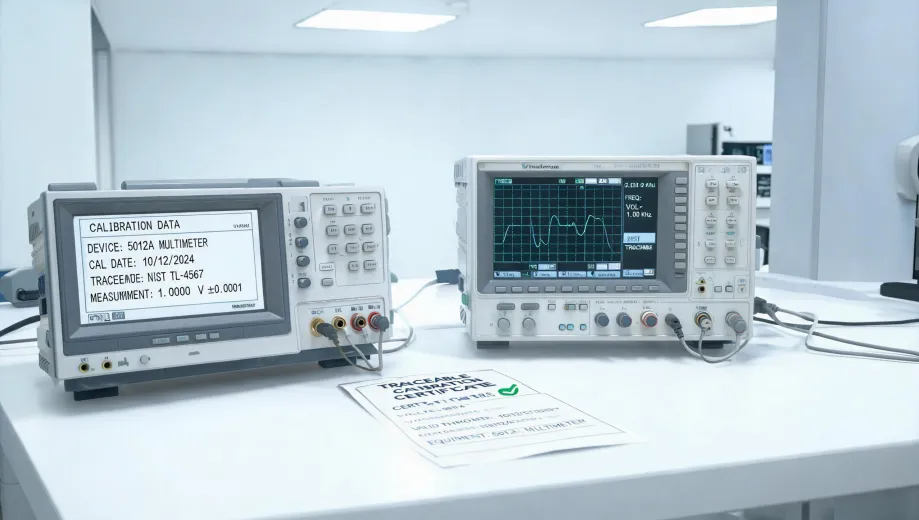
- Can we see the calibration certificate in advance? Is it traceable to the factory?
- Is the lead time within the normal range for this product? If it’s unusually fast, ask why.
- Is factory training or usage support included?
The other items from that same requisition? The checklist handled them:
True RMS multimeters. I went with an authorized distributor—6% more expensive than a no-name channel, but it came with full calibration certificates that audit can actually use.
4-20mA pressure transmitters. Before ordering, I asked the supplier to send datasheets and confirmed the range, accuracy class, electrical connection, and process thread spec. They asked, “What’s your process pressure range?” I forwarded it to quality, got a number back, then ordered. No issues.
Megger insulation tester. Before buying, I watched two short videos on how to use a megger insulation tester—enough to understand that 500V, 1000V, and 2500V map to different applications (low-voltage motors vs. high-voltage cables, for instance). Took 20 minutes. Saved a potential return.
I’ve handled maybe 70-something equipment orders at this point—I haven’t kept an exact count. Most of them go fine. But when something goes wrong, it tends to be the expensive kind.
The thing I keep telling people in my department: five minutes of verification beats five days of rework. It sounds like a cliché, but in procurement, it’s brutally true.
Especially with something like a CMM. A Hexagon coordinate measuring machine isn’t cheap to begin with. Buying the wrong one costs more than money—it costs production time, customer trust, and whatever credibility you’ve built up over three years.