-
Step 1: Don’t Compare Apples to Oranges—Calculate Your Per-Channel Cost
-
Step 2: Value the Software Ecosystem (LabVIEW) as a Hard Asset
-
Step 3: Check Your Calibration and Longevity Requirements
-
Step 4: Plan for the 'What If' Scenarios Before You Order
-
Step 5: Audit the Hidden Fees in the Quote
-
Step 6: Negotiate the Relationship, Not Just the Price
Honestly, when I first started handling our test equipment procurement, I made the classic mistake. I’d look at a data logger or a thermocouple module and think, 'Which one has the best specs for the lowest price?' That’s a fast track to budget overruns.
After auditing over $180,000 in cumulative spending across 6 years, I’ve learned that the real cost isn't on the price tag. It’s in the integration, the software, and the time it takes for your team to just get a measurement. This checklist is for anyone buying National Instruments gear—or any modular test system—who wants to avoid my early mistakes. Here are the 6 steps I use now to make a decision I don't second-guess later.
Step 1: Don’t Compare Apples to Oranges—Calculate Your Per-Channel Cost
This sounds basic, but it’s where most people slip up. You’re looking at a National Instruments thermocouple module versus a standalone data logger from another brand. The standalone box might cost $800. The NI module might cost $1,200. But the NI module is part of a chassis (like a CompactDAQ) that can hold 4, 8, or even 14 modules.
The real calculation:
- Standalone box: $800 for one task.
- NI Module + Chassis cost spread: If you buy an 8-slot chassis for $2,000 and only use one thermocouple module, your cost is $2,000 + $1,200 = $3,200. That looks terrible.
But if you plan to eventually measure voltage, current, and digital signals? You fill those slots. In my experience, once you plan for the second and third measurement types, the per-channel cost of the NI system drops below the “cheaper” alternatives. Basically, you’re paying for a platform, not a single tool.
Step 2: Value the Software Ecosystem (LabVIEW) as a Hard Asset
I used to think software was a 'freebie' or a 'necessary evil.' That was a mistake. The real hidden cost in test equipment is integration time. How long does it take your engineer to write a script to log data from that 101 multimeter or leakage clamp meter?
In 2023, we had two teams. Team A bought a generic data logger. Team B bought an NI CompactDAQ with LabVIEW. Team A spent 3 weeks writing custom Python drivers to get their data flowing. Team B used an NI example program and had their first measurement in 2 hours.
“I get why people go with the cheapest option—budgets are real. But the hidden costs of engineering time add up. That 3-week delay cost us more than the price difference in hardware.”
So, when you see the price of an NI thermocouple module, add a line item for the value of the software that comes with it. For us, that value was about $4,200 in saved engineering hours on our first project alone.
Step 3: Check Your Calibration and Longevity Requirements
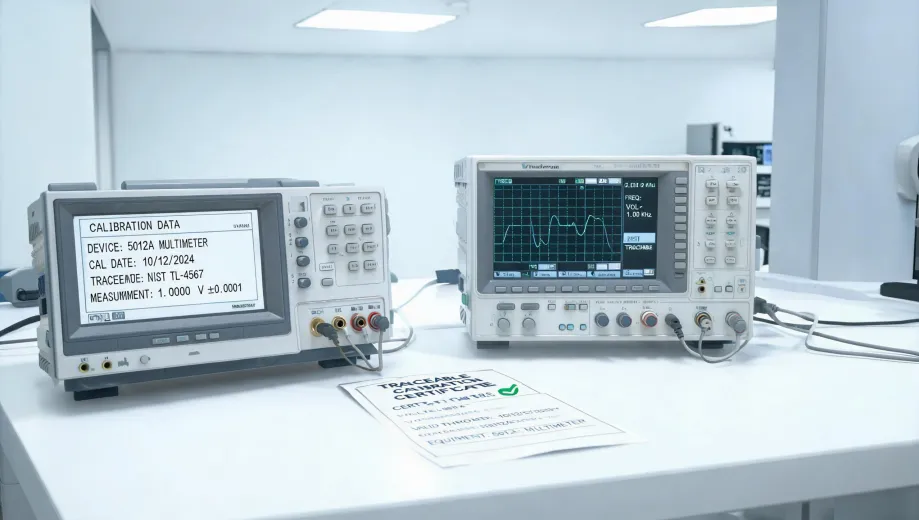
This is the step most procurement checklists miss. A cheap leakage clamp meter might be accurate to ±2%. That’s fine for a 'go/no-go' test. But if you’re validating a design or doing R&D, you need traceable calibration.
NI provides calibration certificates with their modules. More importantly, they keep modules in production for years. We bought a specific PXI module in 2020, and when we needed a spare in 2024, it was still available. The cheaper alternative we looked at had been discontinued.
To be fair, buying from a brand like Fluke gives you longevity too. But the modularity of NI means you can replace a single thermocouple module without redesigning your entire test rack. That saved us from a $1,200 redo when a 'cheap' alternative’s hardware failed and was no longer stocked.
Step 4: Plan for the 'What If' Scenarios Before You Order
I said 'we need a 16-channel data logger.' The sales engineer heard 'we need a fixed 16-channel system.' Result: we got a system that couldn't expand. That was a communication failure on my part.
Three months later, we needed to add vibration monitoring. With the standalone box, we were stuck. We had to buy a second, separate box. With an NI system, you just buy another module and plug it into the chassis.
My rule now: always buy 20% more chassis capacity than you think you need. It costs a little more upfront, but it saves a lot of stress later. When I hit 'confirm' on that larger chassis, I kept second-guessing. 'What if I'm over-spec'ing?' The 6 months until we needed that extra slot were stressful. But when it happened, we didn't miss a beat.
Step 5: Audit the Hidden Fees in the Quote
When I analyzed our 2023 spending, I found that 15% of our 'budget overruns' came from accessories and cables we didn't account for.
Compare quotes carefully:
- Does the NI 101 multimeter module come with test leads?
- Does the thermocouple module include a cold-junction compensation sensor?
Most standalone data loggers include everything in the box. NI uses a modular approach where you buy the sensor, the cable, and the module separately. This isn't a bad thing—it gives you flexibility. But if you don't add up all the BOM (Bill of Materials) items, your budget will look healthy until the checkout cart rings up $450 more than expected.
Step 6: Negotiate the Relationship, Not Just the Price
The 'big brand' fear is that National Instruments is expensive. And if you walk in trying to negotiate a 10% discount on a $2,000 thermocouple module, you’ll be disappointed. They don't play that game.
Instead, negotiate the softer costs. Ask for:
- Free training credits for your team on LabVIEW (a $2,000 value).
- Extended warranty on the chassis.
- Priority technical support for your account.
After comparing 8 vendors over 3 months using my TCO spreadsheet, I chose NI even though they weren't the cheapest. I negotiated a free on-site training session. The 'cheap' option would have saved us $800 on hardware but cost us a week of downtime when something went wrong.
The bottom line: The best part of choosing NI for our data acquisition wasn’t a single spec sheet. It was the peace of mind that when we need to measure a new signal next quarter, we can add a module, not buy a whole new box. That’s the cost efficiency that matters.