-
You don't need a separate data logger, oscilloscope, multimeter, and power quality analyzer. A single National Instruments modular platform can handle all four—and it's likely cheaper and more flexible in the long run.
-
What a modular NI platform actually replaces
-
The contrast that changed my mind
-
When a modular platform isn't the right call
You don't need a separate data logger, oscilloscope, multimeter, and power quality analyzer. A single National Instruments modular platform can handle all four—and it's likely cheaper and more flexible in the long run.
I'm an office administrator for a 120-person manufacturing company. I manage all our test and measurement equipment ordering—roughly $50,000 annually across 10 vendors. When I took over purchasing in 2020, I inherited a drawer full of standalone instruments: a Fluke multimeter here, a Tektronix scope there, a standalone data logger from a different brand. Each had its own power supply, its own interface, its own software. It was a mess.
After 5 years of managing these relationships, I've consolidated most of our bench-top needs into a single National Instruments PXI system with a LabVIEW back end. Here's why I made that call, and what I learned the hard way.
What a modular NI platform actually replaces
Let me be specific. The system I spec'd in late 2023 (delivered Q1 2024) replaced:
- One standalone data logger (was logging 16 channels of temperature and strain)
- One 4-channel oscilloscope (basic debugging and waveform analysis)
- One benchtop multimeter (6.5-digit, used for DC voltage and resistance checks)
- One portable power quality analyzer (used infrequently, maybe 3 times a year)
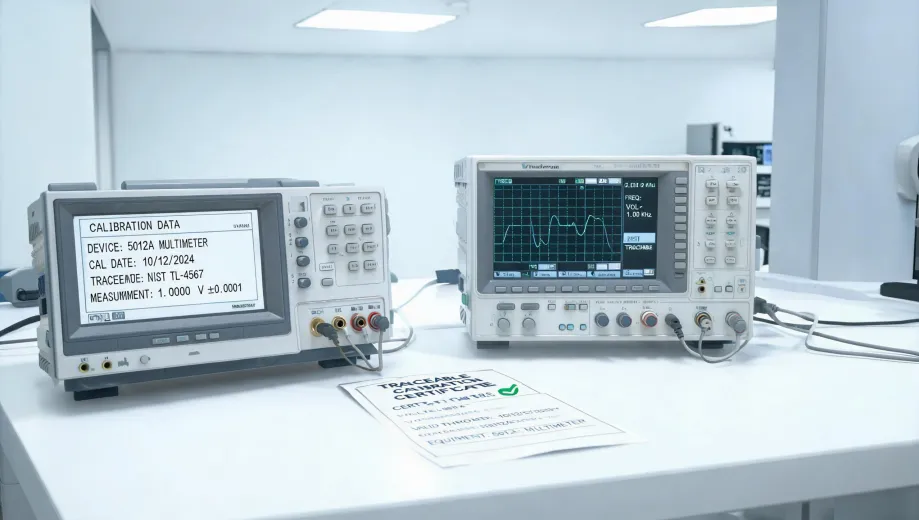
Instead of four boxes with four power cords and four software installs, I now have one chassis (NI PXIe-1073) with three modules: a PXIe-4300 for thermocouple/data logging, a PXIe-5171R (500 MHz scope) for oscilloscope duties, and a PXIe-4081 for high-precision DMM and power quality analysis. The only thing it doesn't do is replace a field-portable handheld DMM—I still buy those for our technicians. But for bench work? It's one system.
People assume the initial cost is higher. What they don't see is the total cost of ownership. The standalone instruments I replaced had a combined purchase price of roughly $18,000 (circa 2018-2020). The NI system cost about $21,000. But the standalone instruments required separate calibration cycles ($300-600 per instrument per year), separate software licenses (some annual), and—the hidden killer—separate training for engineers. Our team spent maybe 40 hours a year just switching between different instrument UIs. With one LabVIEW interface, that's gone.
(Note to self: I should track the actual calibration savings this year. Our 2025 budget shows a 35% reduction in calibration line items. I'll believe it when I see the invoice.)
The contrast that changed my mind
When I compared our Q3 2023 orders side by side—two rush orders for a replacement scope and a new DMM, plus annual calibration renewal fees—I finally understood why the modular approach cost less. The single NI platform meant one procurement process, not four. One vendor relationship, not four. One support contract, not four.
I only believed this after ignoring the advice and doing it the old way first. They warned me about the complexity of integrating modules from different brands. I didn't listen. I spent three months in 2021 trying to get a Yokogawa data logger to talk to a Keysight scope over GPIB. It worked, but it took two consulting calls and a lot of swearing. By the time I got the NI system up and running—largely plug-and-play with LabVIEW—I had my reverse validation.
When a modular platform isn't the right call
I'm not here to say NI replaces everything. It doesn't. Here are the cases where I'd still buy standalone:
- Field work. You can't carry a PXI chassis to a remote site. For portable data logging, I still use a CompactDAQ with a battery pack, but even that is modular. For true handheld DMM work, I buy Fluke units. This is an area where standalone instruments still win.
- Single-purpose, long-term logging. If you need one channel of temperature logged for 5 years, a $200 standalone logger is cheaper than $2,000 worth of PXI infrastructure.
- Legacy compatibility. Some of our clients still require tests run on specific instruments (e.g., a HP/Agilent 34401A for certain MIL-spec certifications). A modular system may not satisfy those requirements.
What was best practice in 2020—buying individual instruments from different vendors—may not apply in 2025. The fundamentals of measurement accuracy haven't changed, but the execution has transformed. If you're managing equipment purchasing for a team of engineers, I strongly recommend running the numbers on a modular platform before buying another standalone unit. The 2020s are the decade of integration, not accumulation.